


International Airport Summit speaker Paul Puopolo, Chief Technology and Innovation Officer, EVP Innovation, Insights, and Technology at Dallas Fort Worth International Airport explains how DFW is putting AI to work in operations and maintenance.
DFW is changing the game in operations and maintenance, with digital and AI empowering our people at the heart of our vision for a connected airport across six million square feet of terminals and 26.9 square miles of airport real estate. The technology is the visible part. The operating model and ways of working that determine whether those capabilities change how decisions get made every shift, every day. That is the harder part, and the focus of this article.
From digital roadmap to strategic clarity and bias for action
DFW has invested in digital strategy and data analytics capabilities for several years. Rapid growth and the AI wave created a clear impetus to step back and align. DFW is scaling from approximately 85 million to a target of 100 million annual passengers, adding approximately 20% more gates, and executing a $12 billion capital expansion. Traditional approaches to operations and maintenance such as scheduled preventative maintenance, reactive repair and contractor management by exception cannot keep pace at that scale.
DFW leadership prioritised two critical areas: proactive, efficient operations and maintenance, and traffic congestion, as the biggest opportunities for change. A systematic shift from reactive and time-based response to predictive and condition-based across six million square feet and 26.9 square miles of real estate. Outcome first, technology in service of it.
Moving beyond scheduled maintenance and static staffing
Behind DFW’s operation sits an enormous and complex physical footprint encompassing HVAC systems, passenger boarding bridges, baggage handling infrastructure, Skylink train cars, roadways, and much more. We issue more than 150,000 work orders against this footprint every year, with addressable operating and maintenance (O&M) spend.
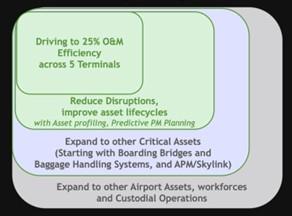
For facilities, operational clarity translated to a concrete target: reduce maintenance cost per square foot by 20–25% by 2030, while improving reliability. Hitting those numbers requires being more precise about which assets need attention, when, and from whom – not simply issuing more work orders or adding contractor headcount.
Early in the execution journey, our north star was the digital twin: a comprehensive, real-time model of critical assets at DFW.
It was the right aspiration, but we needed to prove operational value first. Sensor coverage was uneven, legacy data was fragmented, and frontline teams needed to trust any new system they were expected to use. We adapted – reorienting the programme around outcomes first and letting technology serve those targets. The digital twin remains a critical layer, but it is one piece of our technology architecture.
What we built: RSO (Resource Optimiser) and Asset Health 360
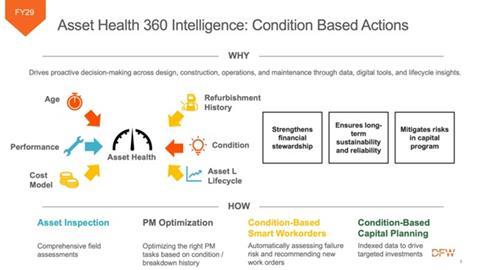
RSO (Resource Optimiser) & Asset Health 360 is our predictive asset health and dispatch platform, organised around two mutually reinforcing layers.
The foundation: Asset Health 360. Work order history, sensor readings, inspection notes, OEM lifespan, breakdown logs, and technician condition notes are fused into a unified health index for each asset currently profiled. The digital twin sits within this layer – continuously monitoring sensor feeds and automatically generating condition-based work orders. Legacy asset management, IoT sensors, and prior data investments all feed into it.
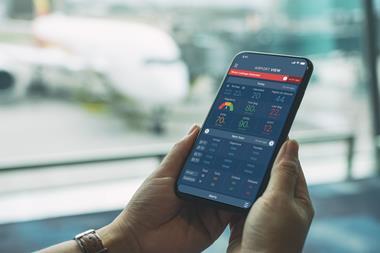
The primary layer above it: Workforce enablement. An AI schedule optimiser matches incoming demand against technician capacity in real time; a manager dispatch cockpit gives supervisors and contractor managers one unified view across every maintenance partner; and a live field application puts prioritised jobs and asset details in technicians’ hands, with execution data captured as they go. That data flows back into Asset Health 360, sharpening tomorrow’s schedule – the compounding effect that distinguishes a connected platform from a set of standalone tools.
Retrofitting and unifying the data
An airport of our age does not start from a clean sheet. Asset history lived in multiple systems, databases, and a generation of unstructured records; each held a piece of the picture, with limited interoperability between them.
Instead of spending months and years perfecting our data and architecture, we built RSO and Asset Health 360 as an integration layer on top of existing systems – starting with the highest-value asset classes and expanding from there.
A less visible but consequential step was using AI to accelerate data cleansing itself: we used AI to surface patterns, flag anomalies, and map gaps in asset coverage – compressing months of manual review into weeks and giving our asset management teams a clear picture of where data was trustworthy and where it needed remediation before the models could act on it.
With the data unified, we can now look at a single HVAC unit and see its complete life: install date, every preventative maintenance, breakdown, current condition, and a real probability of failure – enabling sharper calls on repair-versus-replace, and whether a given preventative routine is still worth running.
Early results
In the first six months of operation across the initial terminal deployment, the platform delivered across all four value levers:
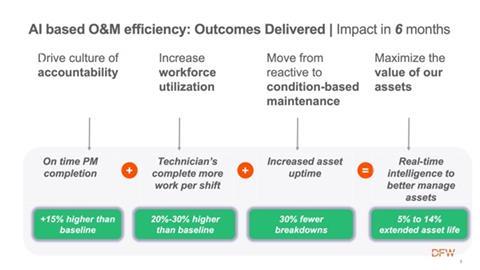
These results cover a subset of our footprint. Our target is a 20-25% O&M efficiency improvement across the full programme scope. Each new wave of assets added sharpens the models and reinforces the business case.
Building the muscle with predictive congestion management
AWARE (advanced warning and response exchange), DFW Airport’s flow management platform, preceded RSO. Working with Boston Consulting Group, we built AWARE first, and it was AWARE that developed the organisational muscle and confidence to take on the far larger challenge of maintenance.
AWARE was not a simple integration. At its core is a groundbreaking neural network approach that learns traffic patterns across DFW’s 26 monitored roadways, fusing 10+ live data streams – flight banks, weather feeds, cameras, construction updates, and more – to identify congestion risks six to 12 hours ahead of time. The platform generates over 100,000 predictions daily, refreshed every 15 minutes. Beyond the technical complexity, delivering AWARE required navigating significant organisational challenges: aligning police, operations, maintenance and ground transportation around a shared operating picture none of them had before. The result was a reduction in peak congestion severity and reaction times cut from six minutes to 10 seconds. AWARE is now moving into recommending actions – passenger communications, digital signage updates, and traffic management interventions – shifting from alerting to actively orchestrating airport flow.
When we turned to maintenance, we did so with the confidence, integration patterns, product team model and organisational trust that the AWARE team had built.
Why this journey worked when so many pilots stall
Working with our partners at BCG, we ran both programmes as products, not projects. We leveraged BCG’s Flywheel approach to outcome-driven transformation – integrated teams owning outcomes end-to-end, with the frontline, business leaders, and fully dedicated, multi-disciplinary technology teams, all with equal seats at the table. This was underpinned by new ways of working, upskilling, modular platforms, and rapid co-creation anchored on the most critical outcomes, and evaluating KPIs regularly.
We brought the frontline in from week one – prototypes in front of real users before writing production code. For RSO, executive alignment to a working MVP in one terminal took four months and then to five terminals in six months. Frontline adoption currently runs above 90% across technicians and 100% across supervisors and the asset management team – a leading indicator of sustained value that matters more than any individual metric.
Lessons for other infrastructure operators
Four lessons stand out as we applied the product-centric approach to our transformation.
1. Start with one big tangible problem. Pick the operational challenge with the clearest value and prove the model there before scaling.
2. Deliver fast and get into users’ hands and co-create. A working tool in 24 weeks beats a perfect design in 24 months. Frontline feedback shapes everything.
3. Treat data and learnings as the lifeblood of the initiative. AI-accelerated cleansing can compress the work – but it still requires deliberate investment up front. Invest in data management.
4. Reshape the workflow and imagine new ways of working, not just the tech for tech’s sake. Each product team and use case inspires new ways of operating, which becomes proof of value for the next one. The operating model compounds.
Looking ahead
DFW’s transformation has been significant, but we are still in the early innings. The products’ goals require scaling and continued improvement. More importantly, our ambition goes further: we want to move from predictive and condition-based to prescriptive capabilities – systems that not only alert our teams to what is coming, but also recommend and eventually initiate the right actions. That is where we can truly change the game for airport operations. The technology is getting there. The operating model we have built is what will let us move fast when it does.
Paul will be speaking at International Airport Summit 2026 in Rome on this very topic. Make sure you are in the room while Paul is on stage to gain insight first-hand and ask him questions.
Register now

No comments yet