



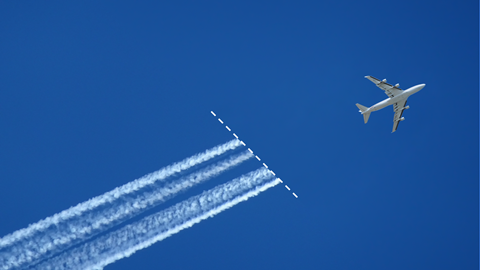
A UK-backed AI trial will reduce warming contrails across North Atlantic airspace, building on earlier airline research and operational flight-routing initiatives.
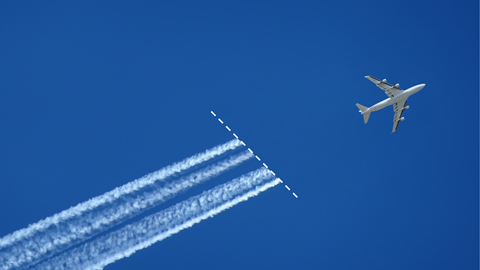
Operation Blue Skies has launched as the world’s first state-backed trial to use artificial intelligence to reduce warming contrails across an entire oceanic airspace, marking a major step towards lowering aviation’s climate impact through coordinated operational changes.
The 30-month programme will focus on the eastern half of the North Atlantic’s Shanwick airspace, which accounts for around 5% of global contrail warming. Unlike previous initiatives involving individual airlines, the programme will test coordinated contrail avoidance across one of the world’s busiest long-haul flight corridors, creating what partners describe as the first large-scale operational blueprint for managing contrail formation across an entire section of controlled airspace.
Contrails, the thin cloud formations created when water vapour condenses around soot particles in aircraft exhaust, are estimated to account for roughly one third of aviation’s overall climate impact. Rather than relying on significant rerouting, Operation Blue Skies will use AI-powered forecasts to identify contrail-sensitive regions and recommend minor altitude adjustments, typically around 2,000 feet above or below an aircraft’s planned flight level, while remaining within standard flight operations.
NATS said the adjustments will be delivered through established air traffic control communication channels, allowing controllers to manage participating flights using existing operational procedures rather than introducing new systems. The organisation added that testing will be scheduled during periods of lower air traffic, helping minimise disruption while allowing controllers to evaluate how the approach performs in a live operational environment.
Two operational trials, each lasting around four months, will take place during the programme. Around 10,000 flights originating from hundreds of cities are expected to pass through Shanwick airspace during trial hours each year, with only a small percentage of flights requiring altitude adjustments to avoid conditions where strongly warming contrails are most likely to form.
Sebastian Eastham, Associate Professor in Sustainable Aviation at Imperial College London’s Brahmal Vasudevan Institute for Sustainable Aviation, said the programme’s climate impact will be independently verified using satellite observations throughout the trial.
“We’ll be using satellite observations to actively monitor whether or not the trial is successful in reducing the formation of contrails in the North Atlantic,” he said.
“Thanks to the location, we’ll be able to take continuous images from two different geostationary satellites, one over Europe and another over the US East Coast, and see in almost real time whether flight altitude adjustments yield the intended effect.”
Eastham added that published modelling by Imperial researchers suggests around 5% of global contrail climate impacts originate from North Atlantic flights, making the trial an important opportunity to demonstrate that AI-powered forecasting can deliver measurable environmental benefits in live operations.
“Our goal is to show, empirically, that the tools we need to predict and avoid the formation of the contrails responsible for that impact are up to the task.”
Earlier airline trials paved the way
The programme builds on several years of operational research into contrail mitigation, demonstrating that today’s announcement represents the next phase of an evolving industry effort rather than an entirely new concept.
In 2025, TUIfly worked with the German Aerospace Centre (DLR) as part of the EU-funded A4Climate programme, with research aircraft following commercial flights through contrail-prone airspace to study how modern engines and operational changes affect contrail formation.
TUIfly also confirmed that it had rerouted several hundred flights during 2025 to avoid contrail-forming conditions, demonstrating that targeted operational changes could be incorporated into everyday airline services. The A4Climate programme also involved organisations including EUROCONTROL, FlightKeys, Imperial College London and other research institutions, helping establish practical approaches to climate-optimised flight routing.
Google’s earlier collaborations with American Airlines, EUROCONTROL’s Maastricht Upper Area Control Centre and FlightKeys similarly demonstrated that AI-generated contrail forecasts could be integrated into operational decision-making for pilots and air traffic controllers, paving the way for the larger-scale Shanwick trial.
NATS said Shanwick was selected because atmospheric modelling shows not only that it accounts for around 5% of global contrail warming, but also that a significant proportion of that warming occurs during the winter months between November and February. By concentrating the two operational trials during this period, the programme aims to maximise the climate benefit of each intervention by targeting the highest-impact weather conditions.
The trial also reflects the operational complexity of managing one of the world’s busiest oceanic flight corridors. While NATS will provide air traffic control services throughout the trial, AirNav Ireland will continue handling voice communications across Shanwick’s oceanic airspace, ensuring existing responsibilities remain in place as the programme is integrated into normal operations.
Operation Blue Skies brings together Google UK, NATS, Contrails.org, Imperial College London, the University of Cambridge and the Met Office. The programme is co-funded by industry partners and the UK Government through the Aerospace Technology Institute programme, while Google UK is contributing £1.4 million in AI research, engineering expertise and computing infrastructure on a pro bono basis.
If successful, Operation Blue Skies could provide a practical blueprint for expanding coordinated contrail mitigation to other busy international airspace corridors, demonstrating how AI, operational planning and collaboration between airlines, air navigation service providers and technology companies can reduce aviation’s climate impact while maintaining safe and efficient flight operations.




No comments yet