

At International Airport Summit operators shared practical lessons on visibility, predictability and trust from one of Europe’s most advanced airside digitalisation programmes.
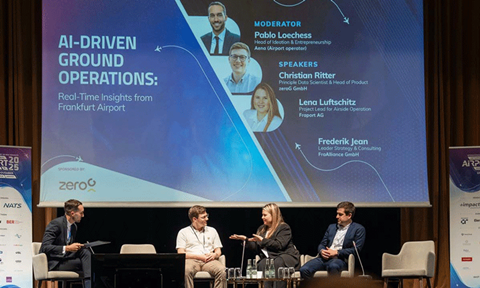
Artificial intelligence (AI) is no longer a future ambition for airport ground operations. At Frankfurt Airport, it is already shaping how aircraft turnarounds are monitored, predicted and optimised in real time.
During the International Airport Summit Berlin panel, AI-driven ground operations, leaders from Fraport, zeroG Lufthansa Group and FRAAlliance shared a refreshingly practical view of what it takes to deploy AI at scale in one of Europe’s busiest and most complex operational environments. The discussion moved beyond theory, focusing instead on data transparency, human trust, collaboration and what really makes AI usable on the apron.
From blind spots to real-time transparency
For many years, turnaround operations relied heavily on assumptions and best guesses. As Christian Ritter, Head of Product & Principal Data Scientist at zeroG Lufthansa Group, put it, operators were effectively “steering highly complex processes like the turnaround without holding the full information into what is happening. This leads to sub-optimal decision-making, which in turn leads to delays and cancellations.”
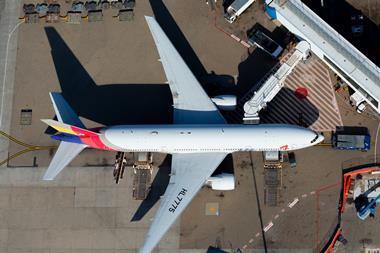
Computer vision has changed that. At Frankfurt, AI systems now monitor more than 30 turnaround events, generating precise timestamps across the entire process, from on-block and unloading through to boarding, pushback and departure.
Lena Luftschitz, Project Lead Digitalisation Airside Operations at Fraport AG, explained how transformative this visibility has been. “Before, we didn’t really know a lot about what was going on during the turnaround process or how far along we were,” she explained. “Now we suddenly have a huge amount of data available to us.”
The challenge, however, is not collecting data but deciding how to use it.
Turning data into action, not overload
A recurring theme was the need to avoid overwhelming already stretched operations teams. Frederik Jean, Leader Consulting & Strategy at FraAlliance, stressed that AI systems must focus attention where it matters most. “What we want to achieve is picking out what’s not going according to plan,” he said, rather than flooding users with every available data point.
From an airport operator’s perspective, one of the most valuable outcomes is improved predictability. “The main thing we want to know is when the aircraft will be ready to leave the stand again,” Lena noted. Predicting aircraft ready time and off-block time allows airports to make smarter, earlier decisions across stands, gates and resources.
For ground handlers, the benefits are just as tangible. Lena highlighted how AI-generated timestamps now show exactly when ULD unloading begins. “Airports don’t have to direct their employees on a best-guess basis anymore,” she explained. “They can send people when they’re actually needed, without waiting around.” This is a great workforce productivity saving.

c: International Airport Review[/caption]
Designing AI around people, not just processes
While the technology is powerful, the panel was clear that success depends on human-centred design. Christian emphasised that AI solutions were co-developed with operational users from the start. “We visited them in the ops control centres, looked at how they work, what information they have and what they actually want,” he said. “It’s not about the tech, it’s about how you integrate it into their daily work.”
This approach has paid dividends in adoption and trust. Lena shared a telling anecdote: “One of the turnaround managers told us, ‘It was really great seeing what I suggested actually appear in the dashboard I now use.’ That really helps with acceptance.”
Education also plays a critical role. While AI has become more familiar, Christian noted the importance of explaining how systems work, including their limitations.
People are still the decision makers,” he said. “We just want to give them a tool, and they need to understand the tool to make the most out of it.”
Addressing trust, data protection and resistance
Unsurprisingly, introducing cameras and AI into airside environments raises concerns. The panel did not shy away from this. “Naturally people don’t like being filmed while they work,” Christian acknowledged. Engagement with workers’ councils and strict data protection measures were essential. “We made sure we don’t detect individual people,” he explained. “We track the process, not performance.”
Frederick added that resistance to new systems is natural. “If you show transparency from the beginning and make it clear this is a supporting system, not a replacement for humans, you can really gain trust.”
Crucially, trust-building does not end at go-live. “You’re never really done,” Christian said. “We still collect feedback and amend the system, so it stays relevant for users.”
Collaboration as a force multiplier
Frankfurt’s progress has been accelerated by close collaboration between the airport, airline and FraAlliance, a joint venture that helps align objectives and data governance.
“In the beginning, everyone optimises their own systems,” Frederick explained. “What you need is a common vision, shared KPIs and shared goals.” Data sharing is often the hardest step, but once trust is established, momentum builds quickly. “After that, you can proceed with the project at the speed you want,” he continued.
Lena echoed this sentiment from the airport side. “At the end of the day, we’re all working towards the same goal: smooth and efficient operations,” she stated. “Airlines, ground handlers and service providers all benefit if everyone has the same information.”
Start small, scale safely
Operating in a safety-critical environment means innovation must be carefully staged. The panel repeatedly returned to the value of proof-of-concept projects, pilots and incremental rollouts.
“We cannot just stop operations for a day,” Christian said. “So, we keep the risk low at the beginning, start with a pilot, then gradually expand.” Importantly, fallback processes remain in place so operators can revert to existing methods if needed.
This phased approach also helps with regulatory hurdles. As Frederick pointed out, GDPR is “not a showstopper, but a hurdle.” Addressing data protection early, in parallel with technical development, makes it manageable.
What this means for the wider airport community
Frankfurt’s experience shows that AI-driven ground operations are not about futuristic automation, but about visibility, collaboration and trust. Even with imperfect data and partial coverage, as Christian noted, “tracking 80% is still much better than tracking nothing.”
For airports watching from the sidelines, the message was clear: be brave enough to start, small enough to learn and collaborative enough to scale.
These are exactly the kinds of real-world insights that make the International Airport Summit such a valuable forum. As AI, data sharing and operational resilience move higher up the airport agenda, next year’s summit promises even deeper discussion on how innovation can be safely and practically embedded into daily operations.
For those shaping the future of airport performance, Frankfurt’s journey is a compelling reason to be part of that conversation.