





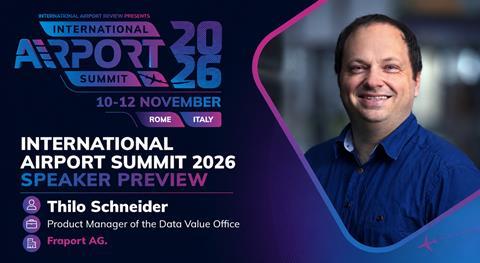
Modern airport architecture creates the possibility of prediction. But only capable people, clear ownership and practical processes turn that possibility into operational value explains Thilo Schneider, Product Manager of the Data Value Office at Fraport AG.
Renewal starts with readiness
Technical renewal rarely follows a perfect master plan. In a complex airport environment, major steps often become possible when a business need, an investment window, or the replacement cycle of a legacy system creates the right opening. The decisive question is therefore not whether an opportunity will arise, but whether the organisation is ready to recognise and seize it.
Readiness has two dimensions. The first is a technical target picture: a clear view of how systems should exchange and expose data in the future. The second is an organisational and business vision: leaders and specialists must understand what data can make possible, which responsibilities they carry and how new capabilities can improve operations. Technology creates options; people and governance convert those options into value.
From interfaces to a data nervous system
For many years, integration meant building a connection between one producer and one consumer. Each new request added another interface, dependency and maintenance obligation. The individual connection might work well, but the accumulated landscape makes change slow: a producer must know its consumers, consumers depend on source-specific formats, and useful data remains difficult to discover or reuse.
At Fraport, our technical answer is the Central Data Hub: a logical, company-wide hub that decouples data producers from consumers and provides common access points. Asynchronous, event-based communication runs through Apache Kafka; synchronous request-response communication uses web APIs registered in the central API management platform. Schemas, classifications and flows are integrated with the data catalogue and analytics platform.
The goal is not centralisation for its own sake. Connecting a new source or consumer should become a repeatable, governed process, rather than another bespoke project. Once a data service is connected, it can be discovered, consumed by multiple applications and made available for historical analysis without rebuilding the same pipeline for every use case. The hub becomes a data nervous system: events and requests can move across the organisation while producers and consumers evolve more independently.
Make data usable by default
Architecture alone does not create a data-driven company. Fraport’s Data & Analytics Strategy treats data as an enterprise asset and connects platform, access, governance and skills. Its ambition is to break down data silos, make data centrally and securely available and enable employees across the organisation to generate value from it.
Right to know, not need to know
A central element is the shift from “need to know” to “right to know”. The traditional approach starts with restriction: employees must demonstrate why they need specific data. Our approach reverses that assumption. Employees should be able to access data unless a documented legal, contractual, security or sensitivity reason speaks against it.
This does not mean unrestricted openness. Data is assigned to transparent access classes. “Internal” is the default for much of the company’s data. More sensitive information can require training before access, while personal, licensed or highly critical data remains subject to selective approval. The result is controlled democratisation: broader reuse becomes easier, while accountability and protection remain explicit.
Literacy at every level
Even accessible data creates little value if decision-makers cannot interpret it or teams must wait for a small group of central experts to answer every question. Data and AI literacy therefore needs to reach the whole organisation, but it should not mean identical training for everyone.
Leaders need to understand the organisation’s data landscape, question analyses, recognise bias and uncertainty, distinguish conventional analytics from AI, and judge use cases by business impact, feasibility, data availability and quality. They also need to create the conditions for data-driven work in their teams. At Fraport, leadership learning combines practical sessions with cross-functional use-case work so that knowledge is applied to real responsibilities.
Data practitioners and analysts need hands-on capabilities in preparation, visualisation, business intelligence, low-code tools and the platforms used in the company. Data scientists require deeper learning in statistics, machine learning, experimentation and model lifecycle management. For employees moving into data practitioner, analyst or data scientist roles, structured learning journeys combine flexible self-learning, live teaching, peer groups, mentoring and Fraport-specific basecamps. These formats provide the methodological, technical and governance knowledge they need to take on their new responsibilities in an operational context.
This distributed capability matters. Business teams should be able to handle basic analytics, automation and data tasks within shared guardrails instead of treating central IT as the unavoidable bottleneck. Central experts remain essential for platforms, standards, security and complex engineering, but they can focus on the work where their expertise adds the greatest value.
Governance that enables reuse
Data responsibility starts with the business process. Data is created because an operational process is executed, and the business is best placed to define what that data means, what quality is required and how it can contribute to decisions beyond the boundaries of the individual process. For every relevant process, a Data Owner in the business therefore carries accountability for the data generated and used there. IT provides platforms, integration mechanisms and technical expertise, but it cannot assume business ownership of the data.
The Data Owner translates process accountability into concrete decisions on meaning, classification, compliance, access, usability and source-data quality. The role belongs close to the operation, where business context and consequences are understood. Data Product Owners shape curated, consumer-oriented data products; Data Stewards maintain descriptions, context and operational quality; and Domain Owners align definitions and decisions across related data. A catalogue, business glossary, technical metadata and measurable, use-case-specific quality rules give them practical instruments.
The aim is not an additional layer of bureaucracy, nor is it to turn a business challenge into an IT problem. Good governance creates an unbroken line from the process to its data and its accountable Data Owner. People can find the data, understand its meaning, identify who can decide on its use and see which conditions apply to reuse. This supports a mindset shift from “I optimise my own process” to “I run my process well and provide a reliable data contribution to the wider operational system.”
Culture is the strongest enabler
None of these measures works in isolation. A modern platform without ownership and confident users becomes underused infrastructure. Ambitious use cases without shared architecture and governance recreate the silos they were meant to overcome. Restricted access prevents experimentation; access without literacy or accountability produces mistrust.
Architecture, right-to-know access, governance roles, data products, quality processes and role-based learning reinforce one another. Together, they change how people work with data every day. That change – the establishment of a genuinely data-driven corporate culture – is the strongest enabler for moving from isolated, ad-hoc analysis to repeatable predictive analytics and scalable AI.
Progress should therefore be judged not simply by the number of models built. More meaningful signals are how easily sources and consumers can be connected, how much trusted data is reused, how quickly teams can move from a question to an informed decision, and whether predictive capabilities become part of normal operations.
Prediction starts before the algorithm
Moving from firefighting to foresight is not primarily an AI project. It is a continuing organisational transformation, enabled by an adaptable technical foundation, practical governance, accessible data, informed leaders and capable practitioners. When data can be found, trusted, understood and reused as part of everyday work, prediction is no longer a specialist experiment. It becomes an organisational capability and each renewal opportunity can move the airport another step towards foresight.
I will be discussing this topic in more depth during my session at the International Airport Summit taking place in Rome on 10-12 November 2026.
I will be in conversation with Giovanni Russo, Chief Operating Officer of Geneva Airport and others during the fireside chat, ‘From firefighting to foresight: building the data foundation for prediction’.
Make sure you register for your free* ticket to attend the event to join us in Rome and network with me and my panellists afterwards.
* Free aviation leader tickets are applicable to senior managers and above from airports, airlines, regulatory bodies and aviation authorities.








No comments yet