

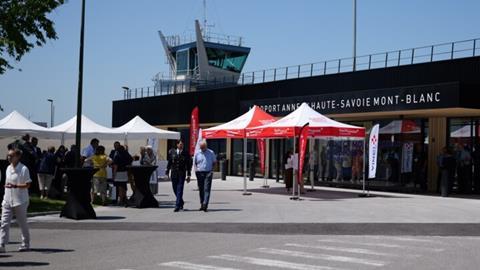

Aurélien Donche, Director of Annecy Haute-Savoie Mont-Blanc Airport, shares how its newly refurbished terminal is enhancing the passenger experience, while investing in energy-efficient infrastructure is preparing the airport for future air travel.
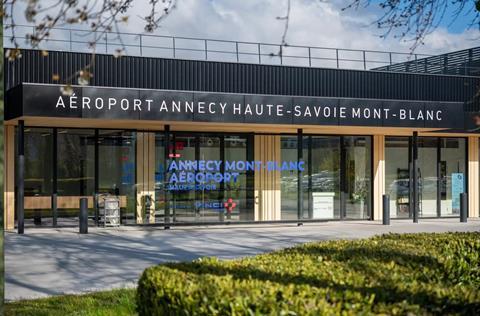
Annecy Haute-Savoie Mont-Blanc Airport inaugurated its fully refurbished terminal on 26 May 2026. The project is the outcome of a close and successful collaboration between the airport’s owner, Haute-Savoie County Council, and VINCI Airports, who has operated Annecy since January 2022.
The terminal is one part of a €10 million investment plan, agreed when VINCI Airports took over the concession and co-financed with the county council. The plan also covered runway renewal and what Aurélien Donche, the airport’s director, calls “an ambitious environmental policy.”
The terminal work itself had two aims. “Our main objective was driven by a dual ambition to significantly enhance the passenger experience and align our infrastructure with the highest environmental standards,” Donche says.
Three lounges where there was one
Passengers now have three dedicated lounges, replacing just one in the old terminal. There is also a specific area for flight crews, and airport staff have modernised, ergonomic workspaces.
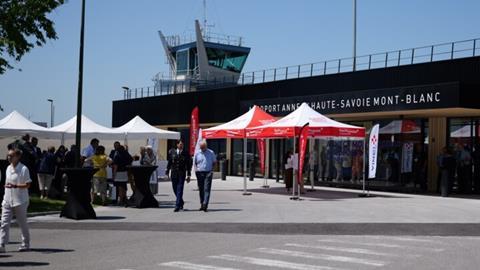
The thermal renovation makes the building more comfortable for everyone who uses it and notably, improves its energy performance. “These improvements collectively deliver a higher quality of service and smoother operational flow,” Donche says.
Access was part of the brief too. The renovation added a new forecourt designed to make access easier for people with reduced mobility, and interior layouts were adapted so the terminal is easier to navigate. Donche describes accessibility improvements as “crucial for an inclusive passenger experience.”
These improvements collectively deliver a higher quality of service and smoother operational flow”
Gas out, SAF and electric charging in
The terminal no longer uses gas. Removing it, together with reinforced thermal insulation, cuts 30 tonnes of CO2 equivalent a year. The airport has also installed LED lighting and electric vehicle charging stations, and converted some of its ground support equipment to electric.
Beyond the terminal, there is a new fuel station that can distribute sustainable aviation fuel (SAF). Donche describes SAF as a practical and immediate alternative to fossil fuels. “Used on its own, SAF can reduce CO2 emissions by up to 90% over its entire lifecycle, compared with its fossil fuel equivalent.”
The same fuel station has a 44kW charging point for electric aircraft. In Donche’s words, it “contributes to the growing nationwide network of charging points,” adding how SAF and the charging installations together prepare the airport for the future of air travel.
Used on its own, SAF can reduce CO2 emissions by up to 90% over its entire lifecycle, compared with its fossil fuel equivalent.”
A renewed airfield and a 2030 date
The runways, taxiways and aircraft stands have been completely refurbished. The work improves safety and reliability for all aircraft movements, lowers the risk of incidents and reduces wear on aircraft. Better parking and circulation areas mean aircraft move more smoothly on the ground, with shorter taxi times and less congestion.
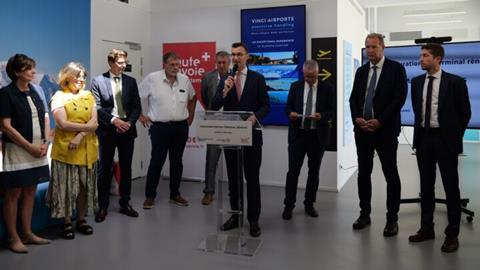
Donache ties this directly to the airport’s commercial position. “Infrastructure modernisation is vital for regional airport growth,” he says. Better operational capability and service quality make Annecy more attractive for business and leisure aviation.
The airport is not doing this alone. “This modernisation, coupled with synergies across VINCI Airports’ regional network, strengthens Annecy’s strategic importance and supports the attractiveness of the Northern French Alps,” he says.
VINCI Airports is aiming for net zero emissions on scopes 1 and 2 across its network by 2050. Its European airports, along with London Gatwick and Edinburgh, have an earlier target of 2030, and Annecy is working to that date. Donche says the €10 million plan, with its focus on energy efficiency, CO2 reduction, SAF and quality of service, makes the airport “a prime example of the VINCI Airports strategic vision.”
Annecy now has a terminal that runs without gas, a fuel station that can supply SAF and a charging point for electric aircraft, on an airfield that has been renewed from the runway to the stands. All of this came out of a €10 million plan shared between the operator and the county council. With the terminal open, 2030 is the next date the airport will be measured against.




No comments yet