
Henk Brandsma, Schiphol Airport’s Strategic Process Developer for Baggage explains how airports can transform working conditions, strengthen operational resilience, and join the next era of baggage handling innovation.
Ask about the characteristics of working in baggage handling and you will get responses of a similar theme from all four corners of the globe: repetitive, unpredictable and physical.
Despite decades of technological progress across the aviation ecosystem, the loading and unloading of baggage has remained one of the most stubborn manual processes in modern airport operations and has barely changed.
The global challenge: a process under strain
Baggage handling is often described as the “last frontier” of airport automation. And with good reason:
- Bags are not standardised; passengers determine size, shape and weight individually.
- Aircraft cannot be docked or buffered like trucks in a warehouse; arrivals and departures follow strict schedules.
- Peaks are inevitable; waves of inbound and outbound flights create unavoidable surges.
- Terminals operate 24/7, leaving limited windows for construction or system changes.
These factors long reinforced a belief that automation at the end of the baggage chain was unrealistic. That belief is now outdated.
Across Europe, North America and Asia, staffing shortages, intensified peak loads and stricter occupational health regulations are putting pressure on baggage handlers. For many airports, the biggest challenge is no longer a delayed aircraft or a system fault. In a tight labour market, providing a safe, healthy and attractive working environment is critically important for retaining staff.
But there is good news: airports are beginning to demonstrate that meaningful mechanisation of baggage handling is not only possible — it is already working.
This article invites you to explore that journey, and to imagine what your own airport could achieve by embracing mechanisation not as an optional upgrade, but as a strategic necessity for workforce wellbeing, operational resilience and future‑proof performance.
How Amsterdam Schiphol Airport has pioneered: proving it can be done
In the early 2000s, Amsterdam Airport Schiphol pioneered a series of breakthroughs that proved something the global industry had long doubted: the loading and unloading of baggage can be mechanised. Even with complex 24/7 operations, and even when bags are unpredictable in size, shape and handling behaviours. While these measures did not yet deliver optimal operational performance and required careful airport planning and integration, Schiphol has taken important steps in recent years by equipping every workstation with mechanical lifting aids. At the same time, the next steps towards full mechanisation have been set in motion. The lessons from Schiphol are now more relevant than ever, offering a compelling blueprint for airports worldwide.
But due to historically low demand for mechanisation, the market for advanced baggage‑handling technologies is still in its early stages. This is why mechanisation must become a priority not just for Schiphol, but for the global aviation sector.
A turning point: new ambitions and retrofit thinking
In recent years, this situation has begun to change. Schiphol is moving towards mechanising its baggage halls, a step that is also required by the Dutch Labour Inspectorate.
But how do you introduce automation that hasn’t evolved in the last decade? And how do you integrate it into baggage halls that are constantly operational?
Schiphol’s answer was retrofit mechanisation:
- Use the existing footprint as a fixed constraint
- Design systems no higher than 2.5 metres to fit under current structures, ceilings and systems above
- Make robots plug‑and‑play replacements for system in- and outputs
- Avoid infrastructure demolition and keep the existing main BHS intact
- Focus on compact, modular systems rather than large monolithic machines.
This retrofit approach resulted in proof of concepts with compact solutions that are internationally scalable and can be adopted far beyond the Netherlands and are applicable for both greenfield and brownfield developments. Below you will find our unloading, loading and process innovations.
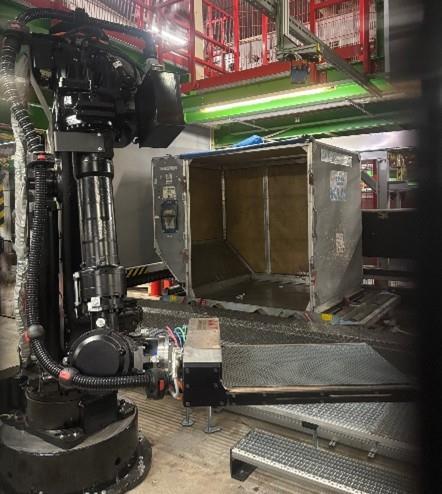
Schiphol introduced a ground-breaking Dutch-built automatic unloading system based on container tilting, shaking and controlled release of baggage. This system was so practical and user‑friendly that the 2009 prototype remains operational today, having unloaded over eight million bags 17 years later. Now the second generation of Moderniek’s bagtipper is operational.
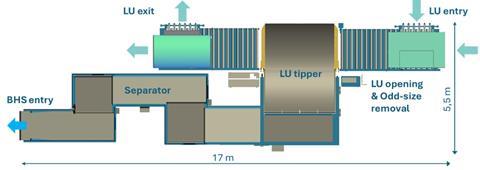
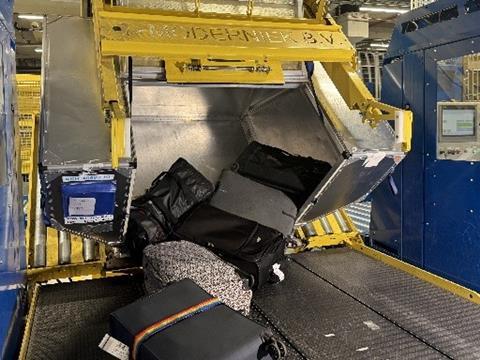
Mechanical Unloading Module for LU’s
- PoC improved version installed in 2025 (UQE)
- Footprint equals conventional quay, exchange offload belt
- Limited integration height < 2900 mm
- PoC on existing location (brownfield)
- Operator tasks:
- Opening LU
- Removing odd-size
- Manual interventions.
- Effective capacity equals or exceeds manual, large dependency of:
- Fill rate, density and load pattern LU
- LU type and quality
- LU make (e.g. rim, edges)
- BHS downstream
- Content (shell, odd-size, cargo straps).
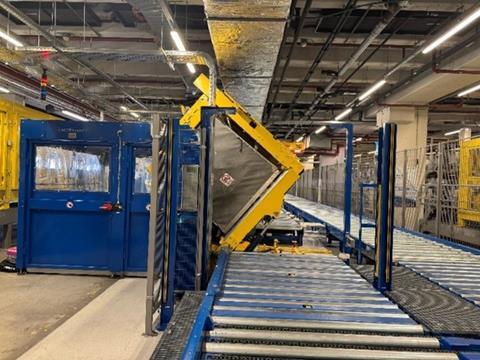
At the turn of the millennium, Schiphol launched what it called the “baggage factory” – a radical rethinking of the entire process. While sorting technology had long been advanced, the final metres of the chain were still fully manual. The biggest ergonomic burden sat exactly where innovation had lagged the most.
Rather than accept this as unsolvable, Schiphol asked a simple, visionary question: “If logistics robots can handle thousands of parcels with a variety of shapes and sizes every hour, why shouldn’t we be able to handle baggage?”
Working with technology suppliers over several years, Schiphol developed the world’s first operational robotic loading system. The first prototype arrived in 2005, and by 2009, a series of six loading robots were running live in production – the first of their kind in the world, the AAT Mk1. Nowadays we are running proof of concepts with two new initiatives: the Mk2 and the Eltonomous. Both fitting within the 2.5 metres height restriction!
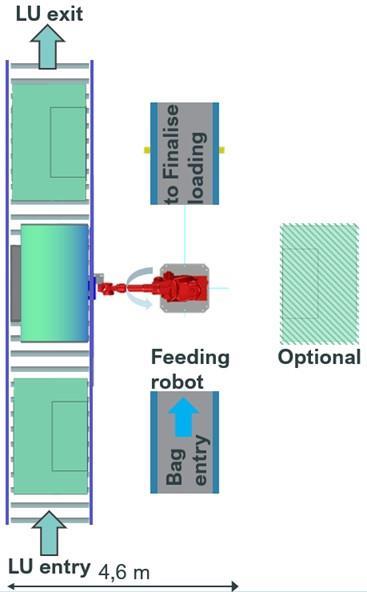
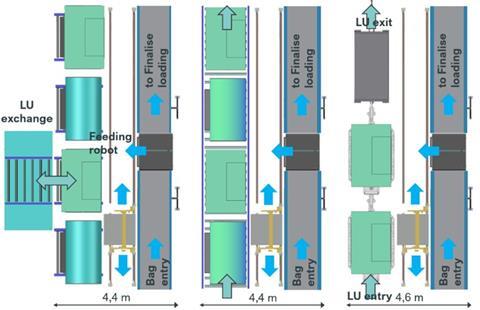
| AAT Mk2 | Elten Logistics Eltonomous |
|
Loading from 1 entry to 1 (or 2) LUs |
Loading from 1 entry to multiple LUs |
|
Relative heigh throughput |
Relative medium throughput (moving) |
|
Based on loading a batch |
Based on lading multiple segregations |
|
Finalise loading by operator |
Finalise loading by operator |
|
Running since 2026 |
Running since 2025 |
|
Also installed in Oslo in 2026 |
|
|
Multiple LU handling possible (ALT/driving) |
Multiple LU handling possible (ALT/driving) |
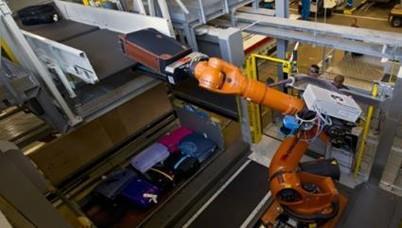
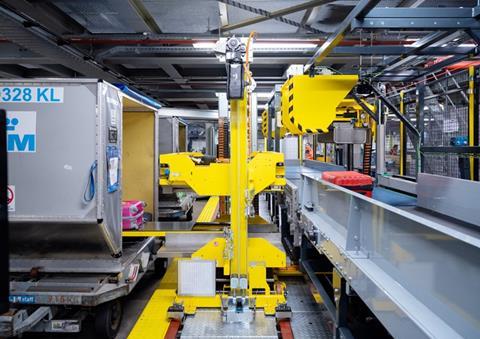
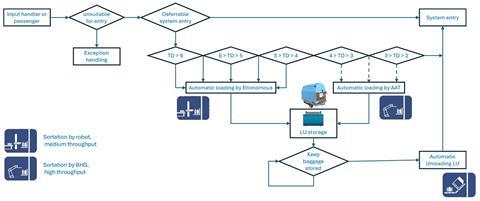
The HenNie concept (named after its creators) reorganises baggage flows around segregations and related volumes and handling individual load units (LUs) instead of entire flights.
Core pillars:
• Handle single LUs
• Distinguish expected number of bags per segregation
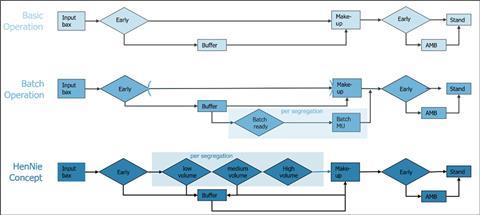
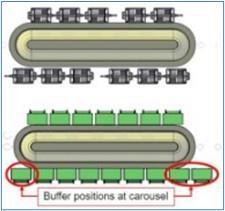
Make-up position efficiency:
Once an LU is filled with a single segregation, it is swapped for an empty one and stored densely.
AGV-enabled LU handling results in:
• More compact shopfloor
• Less dependence on baggage buffers
• Easier mechanisation
• More predictable flow.
Human-centred thinking: airports don’t need futuristic systems, just smart improvements.
Connecting the dots
The best result in a baggage hall can be achieved by connecting not only the baggage flows but the load unit (LU) flow as well. Load units cover containers like AKE and AKH but also carts and airport containers. The LUs are empty after unloading and needed at the make-up locations to be filled. This process of transport and storage of empty and full LUs can be much more efficient by using automated LU transport (ALT) like roller conveyors and AGVs. In this way, space savings and operational improvements can be achieved and the (de)coupling, pulling and pushing is minimised, improving work conditions drastically.
An integrated example using the described components is a compact, stand‑alone buffer/ peak‑shaving system that utilises airport containers, as illustrated below.
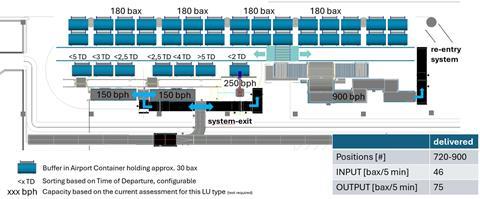
A different approach towards baggage buffers, due to avoiding manual effort with (un)loading leads to a different way of innovation: process innovation!
The future: AGVs, robotics and people-centred automation
Looking ahead, the baggage handling industry is moving towards:
- · Autonomous transport of load units
- · Robotic loading and unloading at scale
- · Compact, modular layouts
- · Continuous-flow operations replacing stop‑and‑go peaks handled manually
- · Jobs that focus on supervision and exception management rather than physical labour.
This is not about replacing people, it is about protecting people and giving them a future in a sector struggling to attract and retain staff.
In fact, airports that invest in human‑centred mechanisation are likely to become the employers of choice in a competitive labour market. There is, however, a hurdle to deal with.
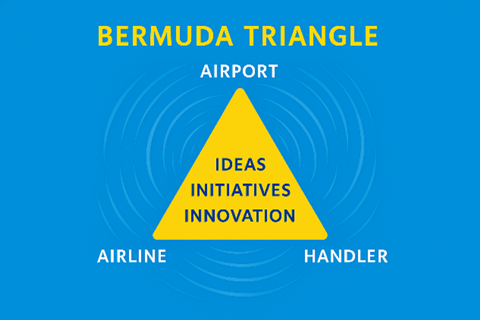
The hidden barrier: the ‘Bermuda Triangle’ of responsibility
If the technology provides possibilities, what is needed to adopt it?
The industry still struggles with a structural issue no robot can fix alone. In most regions, the airport owns the baggage systems, the ground handlers employ the staff and operate the process, and airlines contract the handlers and pay airport fees.
This triangular structure creates a responsibility vacuum. With responsibilities distributed across airports, handlers and airlines, incentives for investment are not always naturally aligned.
International collaboration
In the responsibility vacuum, the airport remains the lead investor for mechanisations as fixed assets. However, no airport can do this alone.
Suppliers will only invest when airports present a united, consistent demand. BOOST aims to resolve this, as an international collaboration with like‑minded airports and objectives to create:
- · Shared innovation roadmaps
- · Standardised specifications
- · Joint testing and data exchange
- · A consolidated global market for mechanisation technology.
This is not merely beneficial – it is essential for the sector. The more airports that join, the quicker mechanisations can become “proven” and the faster suppliers can bring mature, cost‑effective solutions to market.
Airports Council International (ACI World) is starting to collaborate with BOOST already. Also, IATA is looking into baggage automation and recently held a workshop on ‘robotics in baggage automation’.
Whether you are an airport director, a ground handling leader or an airline stakeholder, this moment represents a unique opportunity to:
1. Improve working conditions drastically
2. Strengthen operational resilience
3. Attract and retain talent
4. Benefit from proven technology
5. Join a growing global movement.
A call to action: let’s build the future together
Mechanisation of baggage handling is no longer about prestige projects or technological curiosity. It is about fairness, safety, dignity, sustainability and operational strength.
We stand at a crossroads.
If airports commit, suppliers will follow. If we collaborate, we can accelerate. If we design mechanisation with operators, not for them, adoption will be natural and sustainable.
The next chapter of baggage handling innovation will not be written by a single airport, supplier or airline. It will be written by a community – one that recognises the value of people and the power of mechanisation to support them.
Reach out to BOOST, www.boostbaggage.com, to one of the joined forces of the suppliers of Schiphol, or contact Henk Brandsma at henk.brandsma@schiphol.nl

No comments yet