As part of IAR’s PTE Preview Series, Point FWD reveals what they are going to be discussing and demonstrating at the show.
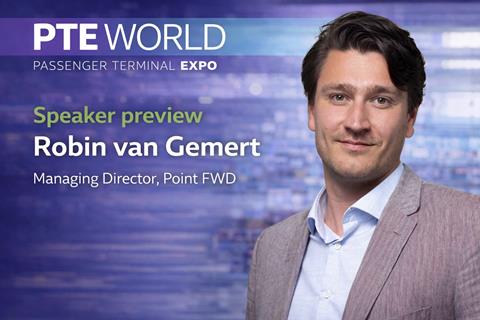
Ahead of this year’s Passenger Terminal Expo World exhibition, Editor Holly Miles sat down with Robin van Gemert, Managing Director at Point FWD, about what it takes to move security screening at airports forward. From transition programmes and operator training to platform-based performance steering, Point FWD focuses on what works in live operations – and hints at a new self-service concept that the team is keeping for an in-person demo only.
For readers who don’t know Point FWD yet – who are you and what do you do?
Robin: Point FWD is an independent airport and security consultancy. Our work is focused on helping organisations move their security operations forward. That typically means guiding security screening transitions end-to-end, developing the operating model around the technology, and building training programs so teams can run new security set-ups confidently. We support airports, operators, OEM partners, and public stakeholders, often in projects where all those perspectives need to come together. We also compile performance insight and scenario testing in our new Advanced Insights Platform (AIP), so improvement work stays grounded in what the checkpoint is actually doing.
You start by establishing a baseline performance overview before making changes. Why?
Robin: Because security is a live operation. Peaks, disruptions, shift changes: everything moves. If you start from assumptions, you end up debating opinions. A baseline shows what is actually happening: where queues build, where alarms spike, where re-checks occur, how lanes behave over time, and what this demands from operators. From there, you can steer change with data-based evidence and track whether it lands in day-to-day operations, not just in a project plan.
Equipment selection is often treated as the headline decision. Where do projects go wrong?
Robin: When equipment selection is separated from process development. New technology changes behaviour: how passengers prepare, how alarms are resolved, how operators intervene, how work is handed over. If the process, procedures, and staffing logic aren’t developed alongside the technical choice, performance becomes a surprise. That is the opposite of our philosophy, and a killer for stable operations. The moment you cannot pinpoint what makes or breaks your throughput, you lose control. With our Advanced Insights Platform (AIP) that integrates checkpoint modelling with dynamic simulation and data-driven insights, our mission is to prevent surprises and keep checkpoints running smoothly.

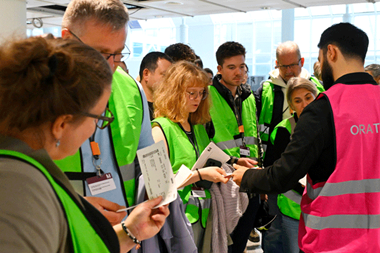
Hands-on support where checkpoint operations take place.
Credit: Point FWD.[/caption]
You seem to put training on the same level as design and implementation. Why?
Robin: Because the operation doesn’t allow for a learning curve for passengers and for operators to “get used to it”. New lanes and machines change what operators look for and what they do next, sometimes in subtle ways that only show up during peaks. We create training programs that prepare operators and supervisors for new technology and procedures, mixing classroom learning with on-the-job coaching and feedback loops. And we put real emphasis on train-the-trainer, so the airport can keep standards consistent. And most importantly, relieve the passenger of having to do anything else but place their items on the conveyor and have the best travel experience possible.
Security and passenger experience are often treated as opposing forces. How do you see that relationship?
Robin: It’s one of the central tensions in our industry, and frankly one of the things I find most fascinating about this work. Security has to be non-negotiable, but the way it’s presented has an enormous impact on how passengers experience an airport. Security screening is one of the most stress-intensive steps and it shapes the total travel experience. When we work on checkpoint design, we look at multiple dimensions simultaneously: the available infrastructure, the technology options, performance indicators, human factors, and the passenger journey itself. You can’t optimize one without affecting the others. A holistic approach isn’t just a nice concept, it’s operationally necessary. I believe that when airports keep the passenger perspective in mind from the very beginning of a checkpoint transition, they end up with better outcomes.

Successful security equipment transitions require checkpoint-wide stakeholder alignment.
Credit: Point FWD.[/caption]
You mentioned AIP. What is the Advanced Insights Platform meant to solve?
Robin: AIP is a new platform we created that is meant to give AvSec (Aviation Security) organisations a single place to work from when they’re improving a security screening checkpoint. AIP combines data capture, dashboarding, modelling and simulation so you can see what’s actually happening, identify the limiting step, and test changes before you roll them into operations. These are known tools we’ve used for years, joint together in a client-facing platform so airports and partners can work with the same logic and the same picture.
What does the “insight” part look like on the ground?
Robin: It can be as direct as standing at the lane with a tablet and tracking how long preparation takes, time spent at the body scanner, time waiting, time repacking. That becomes input for the modelling layer, so you’re not guessing cycle times. A dashboard then helps you monitor KPIs and see where bottlenecks form over time, especially during pilots or change projects.

Contact the team or come find us at PTE for a demo.
Credit: Point FWD.[/caption]
And the modelling and simulation, how does that come into play with AIP?
Robin: We start with a structured process model that calculates capacity per step and highlights the bottleneck. Then we use that as input for discrete-event simulation. That’s where variability matters: what happens when several trays in a row are rejected, or alarms come in bursts? In our simulations you can see how a small disruption turns into a queue and what staffing or layout choices change that outcome.
Many airports already have dashboards, so what does AIP bring that’s different?
Robin: Dashboards tell you what happened. Modelling and simulation help you understand what drives it and what changes will do before you move cones and retrain teams. That’s useful in transition projects, but also afterwards: volumes shift, staffing changes, procedures change. Airports need a way to test “if we do X, what happens to Y?” without learning it the hard way in practice.
You’ve hinted that you’re bringing something new to PTE. What can you say without giving it away?
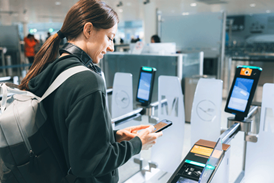
Robin: Everyone working with checkpoints recognizes the same friction point: the moment passengers divest their items. If that takes up too much time, the whole lane pays for it downstream: more operator intervention, more recheck, more stop-start flow. We’ll be demonstrating a new self-service concept focused on that preparation step, with AI used in a very practical way. Are you curious? You should be! We’re bringing a demo version, so come to the stand this PTE and check it out!
Point FWD will be exhibiting at stand B140 during this year’s Passenger Terminal Expo.
Want to schedule a meeting? You can do that here!
About the interviewee
Robin is Managing Director at Point FWD, a company specialised in airport and security consultancy. He is an experienced programme manager and transition consultant, supporting major European airport hubs in managing their full-circle security transitions, from initial capacity studies to procurement and implementation. Robin bridges the gap between strategic planning and daily operations.