

Ras Al Khaimah Transport Authority and Skyports have signed a binding agreement for a four-vertiport advanced air mobility network, targeting commercial services in 2027.
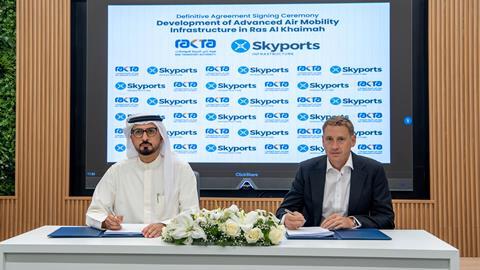
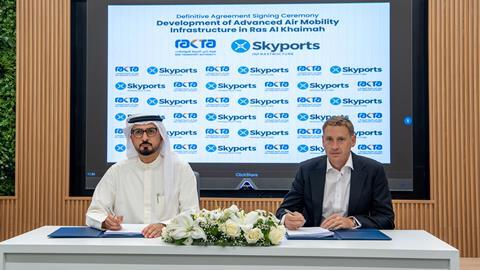
Ras Al Khaimah Transport Authority (RAKTA) and Skyports Infrastructure (Skyports) have signed a binding agreement to develop and operate the infrastructure required for an advanced air mobility (AAM) network across Ras Al Khaimah, with commercial services targeted for the third quarter of 2027.
The agreement was signed at RAKTA headquarters by H.E. Eng. Esmaeel Hasan Al Blooshi, Director General of RAKTA, and Duncan Walker, Chief Executive Officer of Skyports. It was witnessed by Sheikh Omar bin Saqr bin Khalid Al Qasimi, Chairman of RAKTA, and officials from both organisations.
Four-vertiport network planned across Ras Al Khaimah
The definitive agreement builds on a multi-year strategic partnership between RAKTA and Skyports that began in 2024. Following an initial memorandum of understanding and a framework agreement signed in 2025, it moves the emirate’s AAM programme from strategic planning to implementation.
The programme envisages a network of four vertiports, supporting connectivity within Ras Al Khaimah and future inter-emirate air mobility services. Phase 1 will focus on Al Marjan Island and Jebel Jais, connecting two of the emirate’s most important tourism destinations.
Two additional vertiports are planned through subsequent phases as the network expands, subject to further planning, business case development and regulatory requirements.
The first planned inter-emirate connection will be with Dubai, complementing the AAM network already being developed there. The network is intended to provide fast point-to-point connections between key destinations and to support the longer-term development of an interconnected air mobility ecosystem across the UAE.
The vertiport network will be developed with long-term flexibility, allowing it to accommodate different certified aircraft types and approved operators as the AAM sector continues to evolve.
The agreement comes as Ras Al Khaimah enters a period of growth, with major developments progressing across tourism, hospitality, real estate and supporting infrastructure. RAKTA is planning future transport infrastructure in parallel, with AAM intended to complement existing road and public transport networks by offering an option for efficient travel between strategic destinations.
Al Blooshi said: “This agreement is the result of several years of planning and collaboration with Skyports and represents an important step in moving AAM from vision to implementation. Our objective is to establish a safe, integrated and future-ready mobility ecosystem that strengthens connectivity within Ras Al Khaimah and with the wider UAE.”
He added: “By preparing the infrastructure, regulatory framework and network integration early, we are positioning Ras Al Khaimah to be among the region’s leaders in the next generation of mobility while supporting the Emirate’s continued growth as an international tourism and investment destination.”
For Skyports, the agreement is a further step in developing its wider UAE AAM infrastructure network, following progress on its vertiport network in Dubai.
Walker said: “Ras Al Khaimah is undergoing significant growth and has a clear vision for how future mobility can support its tourism and economic development. Building on the progress we have made in Dubai, the planned network in Ras Al Khaimah represents another important step towards a more connected AAM ecosystem.”
He added: “We look forward to continuing our work with RAKTA and the relevant authorities to develop safe, scalable and future-ready infrastructure that supports connectivity within Ras Al Khaimah and, over time, across the UAE.”
The programme supports the objectives of Ras Al Khaimah’s Comprehensive Mobility Plan 2030, which places connectivity, sustainability, innovation and integration at the centre of the emirate’s long-term transport planning, and is aligned with the wider approach to preparing transport infrastructure for population, tourism and investment growth.
Development of the network will continue in coordination with the relevant local and federal authorities, with safety, regulatory compliance, operational readiness and integration with the wider transport network remaining central to the programme.




No comments yet