


Hannah Pollard, Head of Sustainability, shares how Bristol Airport’s new Energy Centre is key in reducing operational emissions, through the use of low carbon thermal energy to cool and heat its terminal buildings.
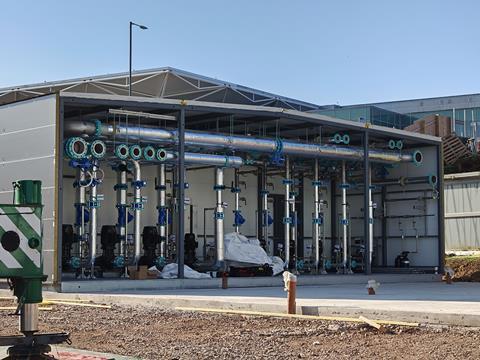
Bristol Airport’s new Energy Centre is a cornerstone of our ambitious target to achieve net zero airport operations by 2030. The multimillion pound investment means Bristol Airport will be one of the first UK airports to remove gas boilers, transitioning to a low carbon energy solution for heating and cooling.
Delivering ambition
In the depths of the pandemic, Bristol Airport committed to achieve net zero airport operations, our Scope 1 and 2 emissions, by 2030. We were the first UK airport to set this ambitious target and subsequently strengthened it by setting an interim target for 2027.
Bristol Airport is the primary airport for the south-west of England and south Wales, serving 10.8 million passengers in 2025. The airport experienced the fastest recovery from the pandemic in the UK, and we have proposals to increase our capacity to 15 million passengers per annum by the late 2030s.
Through our Sustainability Strategy, we committed to reducing our operational emissions by 73% (compared to 2019) by 2027. This strategy sets out achieving the target through three pillars: steadily replacing our vehicle fleet with electric vehicles, rolling out on-site renewables, and decarbonising our buildings.
The Energy Centre will save c.625 tonnes of CO2e annually, which is the equivalent of taking 135 passenger vehicles off the road for an entire year”
This has required significant investment each year. With our buildings, we’ve been fortunate that most of our estate is new, with few buildings older than 25 years. Air source heat pumps have fulfilled the role of gas boilers, with gas most recently being removed from our Air Traffic Control tower. However, the biggest challenge of all was heating and cooling what is by far our largest building – our terminal.
The role of the Energy Centre in our net zero strategy
Heating and cooling our terminal is the last major investment Bristol Airport requires to reach our 2030 target. This decade, we’ve rolled-out electric vehicles both airside and landside, most recently introducing an all-electric fleet of buses connecting us with our city centre and other major population areas. Solar PVs have also been deployed on the space we have available on roofs or on the airfield.
Replacing gas was identified as a technical challenge. Not only would an alternative source of heat and cooling be required, but pipework to and inside the terminal would need to be installed or replaced. As ever, this work would need to be undertaken without significantly impacting our operations.
Our solution
To remove gas from our terminal, we are investing £10 million in an Energy Centre which will produce, store and distribute low carbon thermal energy to heat the main terminal buildings and the terminal extensions in the winter, and cool them in the summer months.
Swapping gas boilers for air source heat pumps at this scale is largely unprecedented and will involve 22 air source heat pumps and one electric boiler, which will provide additional heating and cooling capacity during peak demand periods.
Construction and implementation
Bristol Airport is undergoing a £400 million upgrade, including increasing our terminal floorspace by 50%. This presented both an opportunity to upgrade and decarbonise heating/cooling, but also the challenge of further construction works on what is already a congested site.
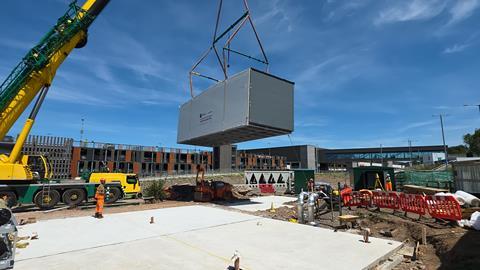
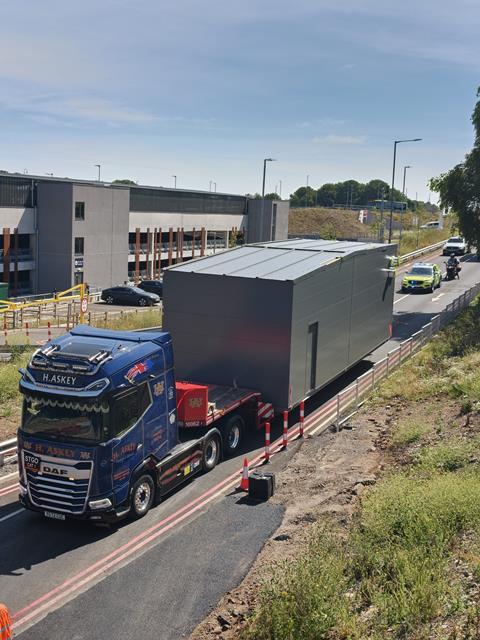
Over the period of four months, the Energy Centre was constructed at an offsite manufacturing facility. Four steel-framed modules were transported by truck to Bristol Airport in July, with the full building being erected on-site in just over two days.
Since March, specialist teams have been working at the airport laying new underground pipes that will transport energy and connect to the heating and cooling system via the terminal basement. The plant room facility contains the pump sets, pipework and valves, which will control the flow of heated and chilled water and manage the overall heating system.
The project is due for completion later in 2026. The current work is installing and connecting pipework from the Energy Centre through our terminal basement into the air handling units.
Delivering carbon savings
The Energy Centre will save c.625 tonnes of CO2e annually, which is the equivalent of taking 135 passenger vehicles off the road for an entire year and is also the same amount of energy used in 77 homes.
Our on-site solar will power the Energy Centre, supported by renewable energy that we purchase via the grid. This final piece of major investment will enable the airport to meet its challenging target of net zero airport operations by 2030, leaving just some residual emissions that will be offset.
Beyond 2030
The facility has sufficient capacity and the ability for further modular growth to meet demand as Bristol Airport seeks to serve 15 million passengers per annum in the longer term. Our net zero airport operations target will remain.
Getting to net zero for our Scope 1 and 2 emissions has been a technical challenge and required tens of millions in investment. Our next phase will be to work towards net zero for all emissions, including surface access and flight, by 2050. We have an annual fund, the Airport Carbon Transition (ACT) Programme, that supports innovative ways to tackle our Scope 3 emissions.
Whilst reducing emissions from flight is a global challenge, we are proud to be involved in three ground-breaking projects to develop zero emissions flight, which are funded by the UK’s Department for Transport. This will culminate in the first liquid hydrogen-powered flight from a UK commercial airport in the next couple of years.







No comments yet