

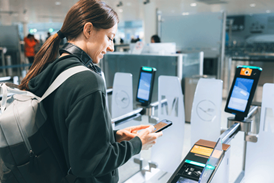


Airports collect vast amounts of data every day from passenger journeys, which can then be distilled into insights enhancing operations, as Kristoffer Plenge-Brandt, Chief Operating Officer of Copenhagen Airports and Maria Dolores Gonzalez, Data Scientist at Aeropuertos Argentina, exclusively tell International Airport Review.

Airports sit at the intersection of dozens of data sources: airline systems, security checkpoints, retail concessions, Wi-Fi networks, parking and increasingly their own digital channels. The challenge has never really been a lack of data, it is joining it up. Across the industry, airports are learning to treat data not as a byproduct of operations, but as the raw material for redesigning the passenger journey itself.
Kristoffer Plenge-Brandt, Chief Operating Officer of Copenhagen Airports, points to airline partnerships as a core input, given how much of the direct customer relationship airlines hold. “We share a lot of data with the airlines,” he explains. “When customers are using the app for different airlines, we can provide them with on-time data in all different ways. There are many opportunities there.”
Maria Dolores Gonzalez, Data Scientist at Aeropuertos Argentina, describes a more centralised approach, feeding operational systems, customer interactions, mobility data and commercial activity into a single CRM or data platform that gradually builds a passenger profile. Her team captures signals ranging from vehicle number plates at terminal entry points to purchases made through the airport’s own marketplace, all layered with interactions from an omnichannel customer service set-up that includes a WhatsApp bot, web chat, telephone support and in-person desks. “The goal,” she says, “is to move from fragmented data to a connected airport ecosystem where every interaction helps us understand passengers better.”
Personalisation and predictive wayfinding
Both airports are using these insights to move away from generic terminal experiences towards something more tailored. At Copenhagen Airport, new digital screens are being rolled out that direct passengers to boarding paths based on their actual needs, alongside terminal-tracking systems that have long allowed the airport to understand where passengers congregate. Plenge-Brandt describes distinct passenger patterns emerging: some travellers want to fast track all the way to the gate, while families are better served by knowing where the nearest playground or family activities are located.
Good data is only valuable if it changes what happens on the ground.”
Aeropuertos Argentina has taken this further, formally identifying six passenger personas built from behavioural data and travel patterns, each with different needs and expectations. Gonzalez calls the result a “phygital” experience, where physical spaces and digital platforms work together. Business travellers are guided towards speed and efficiency, while leisure travellers are steered towards comfort and food options. On the digital side, passengers receive push notifications with real-time flight updates and personalised offers, with automated workflows triggering relevant recommendations at key moments in the journey. “Ultimately,” she says, “the goal is to transform data into meaningful experiences.”
Managing congestion before it happens
Both interviews point to the same underlying insight: uncertainty is what drives passengers to cluster and create bottlenecks. Reducing that uncertainty through timely, accurate information is one of the most effective tools airports have for managing flow.
Gonzalez explains that when travellers lack clear information about flight status or wait times, “they tend to cluster around certain areas of the terminal, which increases congestion.” Aeropuertos Argentina works to push relevant updates to passengers before they even arrive at the terminal, while queue-monitoring systems inside the building help operational teams react quickly to building pressure points. She is careful to stress that technology alone is not enough: “One of the most effective tools is still human interaction on the ground,” with staff organising dynamic queues and guiding passengers towards less congested areas.
Copenhagen’s approach reflects a similar operational philosophy, with terminal tracking data feeding directly into decisions about staffing and passenger support during peak periods, particularly as the airport grapples with high growth and, in Plenge-Brandt’s words, “a lack of capacity.”
Governance, privacy and trust
Handling this volume of passenger data brings serious governance obligations, and both interviewees are candid about the complexity involved. For Copenhagen, GDPR compliance is the central constraint. “We find the way through where we still are in compliance,” says Plenge-Brandt, “but we do what we can to support the customers.” He also points to the importance of internal governance and a single source of truth, a deliberate move away from the data silos airports historically operated in.
Gonzalez frames the challenge in broader terms. At Aeropuertos Argentina, every point of data collection requires a clear, explicit consent mechanism embedded into both digital and physical touchpoints, alongside full traceability of when data was collected, under what consent, and for what purpose. Crucially, the data feeding the airport’s central data lake contains no personally identifiable information. “We work with anonymised or pseudonymised datasets, which allows us to generate insights and improve passenger experience without exposing sensitive information.”
Gonzalez describes the deeper shift required as cultural rather than purely technical. “The real shift is moving from a mindset of ‘we are allowed to use this data’ to ‘we are trusted to use this data’. That’s a much higher bar. Because in the end, trust is what enables scale.”
Turning insight into action
Good data is only valuable if it changes what happens on the ground. Copenhagen’s teams analyse operational, commercial and digital data separately before consolidating findings, a structure designed to ensure insights reach decision-makers rather than sitting unused. The airport’s new digital backbone, developed with a smart airport partner, now shares data with more than 6,000 stakeholders, a step Plenge-Brandt describes as “really a big step forward.”
At Aeropuertos Argentina, Gonzalez highlights forecasting models as some of the highest-value applications of data science. Forecasting load factor by route to support airline negotiations, running retail analytics to optimise store mix and promotions, and forecasting parking demand to enable dynamic pricing and better capacity management. What unites these use cases, she says, is the ability to integrate large volumes of operational, commercial and behavioural data and translate it into real business impact, but only when models move beyond analytical exercises and become “fully embedded into decision-making processes across the entire organisation.”
Where the journey goes next
Both leaders are candid about where data still falls short. Plenge-Brandt acknowledges that Copenhagen’s customer-facing digital platforms are only now catching up to the airport’s operational maturity, with new systems arriving in the terminals this year. “We have been lacking on that part so far,” he admits, “but we are really looking forward to some good, valuable data for the customers.” Gonzalez, meanwhile, points to the organisational challenge of building a unified data platform across a network of airports, each with legacy systems, different vendors and inconsistent standards, a problem that is as much about culture and process redesign as it is about technology.
Data’s greatest value in airports lies not in the dashboards themselves, but in how effectively it is translated into faster decisions, better-prepared frontline teams and a passenger journey that feels less like navigating a system and more like being understood. As Plenge-Brandt puts it, with growth putting pressure on capacity across the industry, getting this right is “crucial for us.”
We will be exploring this topic in even greater depth at the International Airport Summit taking place in Rome on 10-12 November. The ‘Designing smoother airport journeys through data-driven insights’ panel featuring Davide Caenaro, Head of Information Services, Zurich Airport; George Ioannou, Director of Digital Innovation, King Salman International Airport; and Brian Cobb, Chief Innovation Officer, Cincinnati Northern Kentucky International Airport (CVG) wil take place on 12 November.
Make sure you are in the room to hear the discussion first-hand and to network with our stellar line-up of speakers afterwards.









No comments yet