

Riivo Tuvike, CEO of Tallinn Airport shares how data-based decision making and an impactful transition to renewable energy has driven the airport’s journey to carbon neutrality.
Seven years ago, Tallinn Airport began a strategic journey to reduce its environmental impact and help build a sustainability-driven mindset in Estonia. In December 2025, we reached a major milestone: following an independent audit and the confirmation of Airport Carbon Accreditation Level 3+, Tallinn Airport is now carbon neutral.
This achievement was not the result of offsetting with carbon credits to cut corners, but rather the outcome of systematic, targeted and data-driven action. Since 2018, our airport has reduced its carbon footprint from 15,091 tonnes of CO2e to just 552 tonnes today – a total reduction of 96%.
Reduction before offsetting
At the core of our approach is a clear principle: we focus on reducing emissions as much as possible before turning to offsetting. Direct emission reduction shapes our strategy, guiding investment decisions, daily operational processes and sustainability requirements for partners. The remaining 4% of unavoidable emissions were compensated through auditor approved carbon reduction projects.
This achievement was not the result of offsetting with carbon credits to cut corners, but rather the outcome of systematic, targeted and data-driven action.”
Data-driven carbon management
Tallinn Airport’s journey to carbon neutrality began with data. Since 2018, we have consistently collected data on energy use, fuel consumption, waste generation and employee commuting. In 2023, we implemented a comprehensive CO2 data management system, integrating multiple internal systems into a single, consolidated reporting framework.
This allows us to monitor fuel and energy consumption on a monthly basis rather than annually, enabling evidence-based decision-making instead of relying on assumptions or estimates.
Highest-impact categories: electricity, heating and machinery
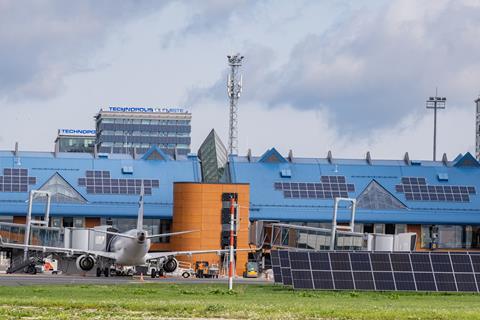
One of the most impactful steps was the transition to renewable electricity. In 2020 we built the first solar park in Tallinn Airport, and by 2025 solar panel installations across Estonian airports were producing 5.75 GWh of renewable electricity annually, covering nearly 50% of our total electricity consumption. The remaining electricity is purchased from certified renewable sources, meaning that emissions from electricity consumption have now been reduced to zero.

Credit: Tallin Airport
The next major step addressed heating. In 2022, an onsite natural gas plant was replaced with district heating, two-thirds of which is generated from renewable energy sources. This change alone reduced our annual CO2 emissions by more than 2,000 tonnes.
The third focus area was the airport’s equipment and vehicle fleet. Over the past three years, we have added nearly 50 pieces of renewable energy powered ground handling equipment, from baggage tugs to ground power units (GPUs). Fleet electrification reduced the airport’s total emissions by almost 25% in 2025. While renewing technical equipment is a costly and long-term process, remaining internal combustion vehicles are now fuelled with renewable paraffinic fuel, significantly lowering their emissions.
People and mindset change as key success factors
Our people and their everyday habits are central to building a sustainable future for the airport. Where diesel engines once dominated the apron, ground handling equipment now operates quietly on electric power. During warmer months, employees even use electric scooters to reach aircraft stands.

Credit: Tallinn Airport
The contribution of our workforce has been substantial: CO2 emissions per employee has fallen from 38 tonnes to just 1.3 tonnes per year.
Sustainability at Tallinn Airport is not a slogan, but the result of a long-term mindset shift. Considering impact on the environment has become a natural part of our daily work. Through training programmes, waste sorting, environmental awareness months, green mornings and employee involvement in sustainability discussions, we’ve fostered a culture where every employee feels responsible for, and empowered by, their positive impact.
Our ambition is to lead by example and demonstrate that meaningful change is not only necessary, but achievable.”
Investments in solar parks, energy-efficient buildings certified to LEED Gold and Silver standards, and the testing of green technologies – including the BSR HyAirport hydrogen project – reflect how organisational ambition and the commitment of individual project managers and specialists come together to drive the region’s green transition.
Progress depends on strong collaboration with our partners
Nearly 80 companies operate on Tallinn Airport’s premises, many of them international subsidiaries. Their activities account for a significant share of the airport’s indirect emissions. To move forward together, we introduced partner environmental impact assessments and CO2e reduction requirements for vehicle fleets in 2024.

Credit: Tallinn Airport
The goal isn’t to regulate for the sake of it, but to work together to reduce our shared footprint.
One of the main challenges has been collecting and aligning environmental data from our partners, as sustainability reporting is still developing for many organisations.
The good news is that momentum is growing, and we expect engagement to increase over time as we jointly develop solutions to address even the complex challenges.
Supporting national climate targets
Our work directly supports Estonia’s national climate and transportation sector objectives, with a focus on energy efficiency, increasing the share of renewable energy and reducing environmental impacts. As Estonia’s main air gateway and business card, Tallinn Airport has a level of visibility that extends beyond national borders into Europe.
Our ambition is to lead by example and demonstrate that meaningful change is not only necessary, but achievable.
Looking beyond carbon neutrality
While carbon neutrality certification has been achieved and emissions reduced by 96%, this is not the end of the journey. We paused briefly to reflect on what has been accomplished, but significant work remains – particularly in addressing indirect emission sources.
This will require more precise data, stronger collaboration with airlines and tenants, and the adoption of innovative solutions. Every new project undergoes environmental impact and risk assessments, and all new buildings are developed in line with internationally recognised sustainable construction standards.
Engagement with partners and the wider community will become increasingly important, as the airport’s environmental footprint extends well beyond its perimeter fence.
A journey that proves the value of ambition
Tallinn Airport’s path to carbon neutrality demonstrates that sustainability is built not on promises, but on metrics, consistency and cooperation. Carbon neutrality was not achieved alone, but together with our employees, partners and the community.
See you at the cosiest airport in the world!

Credit: Tallinn Airport
Riivo Tuvike is the CEO of Tallinn Airport and an experienced professional and manager with proven experience in aviation and banking. Tuvike was the first Estonian to be elected to the ACI Europe Council in the summer of 2022. He holds a master’s degree in Strategic Management and bachelor’s degree in International Business.