


Talha Habib, Civil Engineer at Pakistan Airports Authority (PAA), outlines the 18‑month rehabilitation of Jinnah International Airport’s primary runway, restoring dual-runway capacity and strengthening operational resilience at Karachi’s busiest aviation hub.
Over several years, Jinnah International Airport (JIAP) operated under a constrained set-up, with its secondary runway, 07R/25L, sustaining the full volume of aircraft movements while the primary runway, 07L/25R, remained non-functional. While this maintained continuity, it placed sustained pressure on airfield capacity and limited long-term resilience.
The primary runway was originally constructed in 1961. Over time, the facility experienced progressive pavement deterioration, including surface wear and structural fatigue. The runway exceeded its design life in the early 2010s and remained out of service for an extended period thereafter. During this phase, the secondary runway became the backbone of the airport, handling all arrivals and departures.
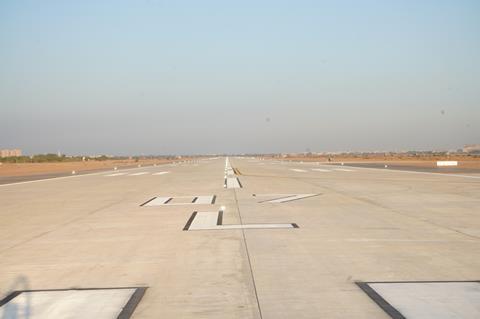
The rehabilitation of this critical infrastructure was therefore a key priority. Restoring the runway brought back dual-runway capability, improving flexibility and providing greater resilience during disruptions.
Delivering a comprehensive airside upgrade programme
As the principal international gateway serving Karachi, Pakistan’s largest city, JIAP underwent an 18-month airside infrastructure upgrade programme between July 2024 and January 2026.
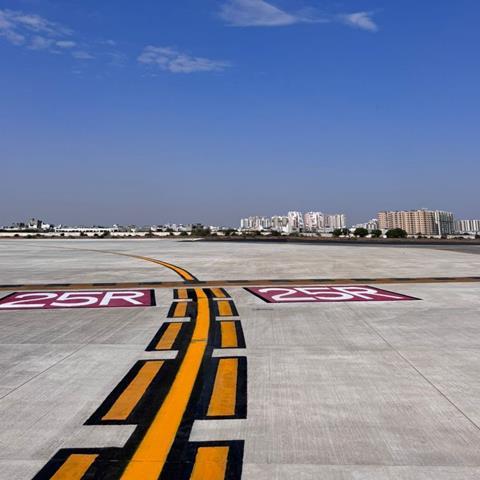
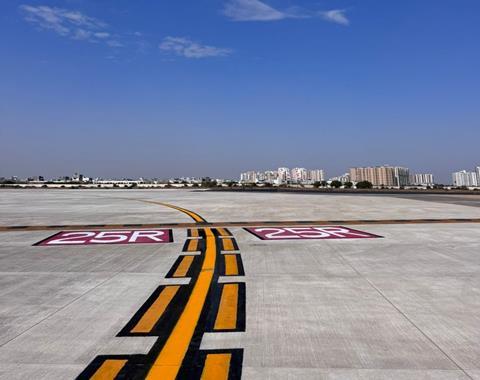
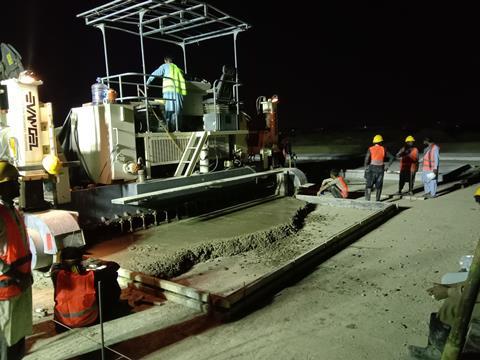
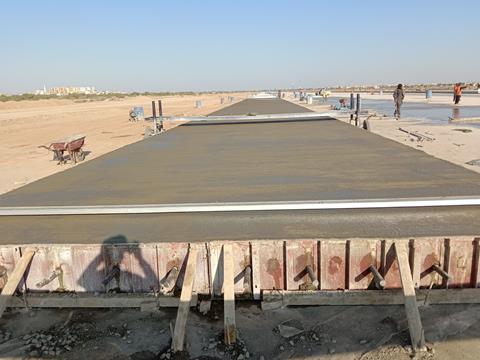
At the centre of the project was the rehabilitation and extension of the primary runway. The runway, previously 3,200m in length, was extended to 3,500m and widened from 60m to 75m, bringing the asset into ICAO Code 4F compliance. The primary airstrip is now positioned to enable operations by wide-body aircraft such as the Airbus A380. Key construction activities associated with these works are illustrated in Figures 2 and 3 below.
In addition to pavement rehabilitation and extension, the programme included upgrades to key supporting airside infrastructure. Three primary taxiways – Golf, Quebec and Foxtrot – were reconstructed, along with the refurbishment of multiple link taxiways, improving connectivity across the airfield and supporting Code 4F operations on the upgraded primary runway.
The programme also included the development of an upgraded stormwater drainage system. This was designed not only to improve surface water management but also to connect with the city’s drainage network. The system incorporates storage provisions that may support future water recycling and conservation initiatives.
Airfield lighting and navigation systems were also modernised to improve reliability, particularly in low-visibility conditions. The upgrade included a Category I Airfield Lighting System (ALS) and an enhanced Instrument Landing System (ILS), supporting safer approach and landing operations. A centralised airfield lighting management system (ALMS) allows better control and monitoring of lighting across the airfield. A new vault station was also constructed to provide a reliable and redundant power supply, ensuring these systems remain operational at all times.
Maintaining operational continuity in a live aerodrome environment
This existing set-up was key to making the project feasible. With the secondary runway already handling full traffic demand, major rehabilitation works could proceed on the principal runway without introducing significant disruption.
The project was led by senior officials from the Pakistan Airports Authority (PAA), Pakistan’s national aviation service provider. Project Director Zahid Ishaque, and the wider leadership team viewed the rehabilitation not only as a runway upgrade, but as a long-term resilience measure for the airport.
The reconstruction was carried out within a fully active aerodrome environment, requiring a careful balance between infrastructure renewal and uninterrupted flight operations. “Maintaining uninterrupted operations remained a central priority throughout the project,” the Pakistan Airports Authority (PAA) noted.
Close co-ordination between construction teams and air traffic control (ATC) was essential, particularly in critical areas such as the Quebec taxiway. Unlike other taxiways, Quebec provided a direct connection between the two runways at their ends, making it a vital link in aircraft ground movement. In situations where alternative routing was limited, it often became the only available taxiway. Careful work sequencing and continuous oversight in this area ensured that aircraft movements remained unaffected.
This demonstrates that, even in constrained environments, effective planning and co-ordination can enable major infrastructure renewal without compromising operational performance.
Safety and risk management as a core priority
The project reflected JIAP and Pakistan Airport Authority’s strong emphasis on safety, which remained central throughout and was managed within the framework of the aerodrome’s safety management system (SMS).
Safety was prioritised from the outset. Pre-construction safety assessments, along with project-specific environmental and health and safety plans, established a strong foundation for risk mitigation.
During implementation, risks were actively managed through regular health, safety and environment (HSE) inspections, compliance monitoring, and targeted assessments for high-risk activities.
A robust combination of workforce preparedness and site controls ensured the project was completed without major safety incidents. Workforce training included daily toolbox talks and emergency preparedness measures such as fire safety training. Given Karachi’s very high summer temperatures, effective heat stress mitigation measures were also implemented.
Strict site controls included restricted access, mandatory personal protective equipment (PPE) compliance, and clear demarcation of work zones, helping maintain a safe working environment.
Given the sensitivity of airside operations, all construction activities were closely co-ordinated with ATC under established procedures. Continuous monitoring through incident reporting systems, lost-time injury tracking, and foreign object debris inspections ensured that construction activities did not compromise aircraft operations.
This approach enabled the effective management of both construction and operational risks while maintaining compliance with established safety and environmental standards.
Enhancing capacity and long-term resilience
The project was delivered within the approved budget and schedule, with no reportable safety incidents recorded during construction.
The completion of the primary runway rehabilitation marks a significant step in restoring balanced airfield operations at JIAP. With both runways now operational, the airport is better positioned to manage traffic demand, improve scheduling flexibility, and enhance overall efficiency. The upgraded infrastructure is expected to improve operational reliability and reduce constraints.
More broadly, the project highlights the importance of timely infrastructure renewal in maintaining airport resilience. While sustained reliance on secondary infrastructure can preserve continuity, it also places long-term pressure on operational flexibility. Strategic rehabilitation of critical primary assets – supported by close co-ordination between engineering, operations and ATC – remains essential to sustaining safety, capacity and performance in live airport environments.
The project demonstrates that legacy airside infrastructure can be renewed in high-demand environments without compromising operational continuity.





No comments yet