



A Cranfield University report on Exeter Airport’s winter hydrogen trial finds dual-fuel ground power equipment cut diesel use and emissions with minimal operational disruption.
Exeter Airport (EXT) has completed a winter trial of dual-fuel hydrogen-diesel ground power equipment, generating new operational evidence to support the safe and practical introduction of hydrogen-powered ground equipment across the aviation industry.
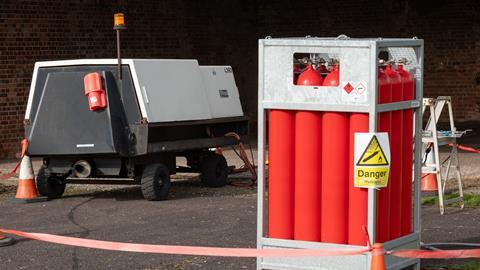
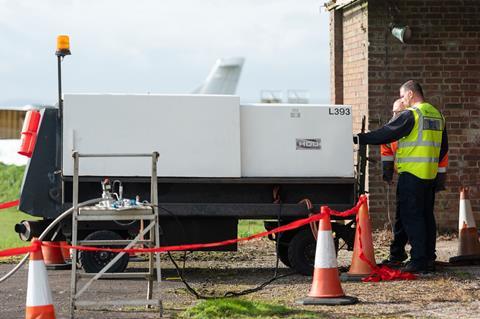
The trial, led by Exeter Airport, Cranfield University and ULEMCo, tested a dual-fuel hydrogen-diesel ground power unit (GPU) over multiple days in winter conditions. A new Cranfield University report finds the equipment performed safely and reliably, delivered measurable reductions in diesel use and carbon emissions, and required little change for the ground teams operating it.
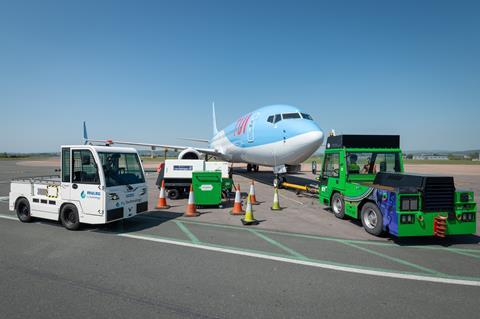
The Winter Operations HyGPU project follows the Zero Carbon Turn trial at Exeter Airport in April 2025, which achieved several UK firsts when three hydrogen-powered technologies supported the turnaround of a TUI Boeing 737. The latest project received funding and support from Connected Places Catapult and regulatory oversight from the UK Civil Aviation Authority (CAA).
Across eight operational days, the equipment completed 15 tests lasting almost six hours in total. It consumed 7.41kg of green hydrogen, displacing an estimated 24.23 litres of diesel and avoiding approximately 63.9kg of carbon dioxide emissions.
No safety incidents or significant operational problems were reported, while ground crew found little practical difference between operating the converted equipment and a conventional diesel GPU.
The report estimates that converting all seven of Exeter Airport’s existing GPUs to the same dual-fuel system could save more than 11,000 litres of diesel and approximately 35 tonnes of carbon dioxide equivalent each year.
Dr Thomas Budd, Associate Professor of Airport Decarbonisation at Cranfield University and author of the report, said: “This trial has taken us another step beyond a one-off demonstration and given us valuable operational evidence about how dual-fuel hydrogen equipment performs in winter conditions.”
The trial also provided evidence about where hydrogen may be most effective within an airport’s ground equipment fleet.
Ambient temperatures during the tests ranged from 4°C to 14°C, with the report finding no clear evidence that lower temperatures directly affected the GPU’s technical performance. However, periods of inactivity, including overnight cold starts, may delay the point at which the equipment begins using hydrogen.
The dual-fuel unit starts on diesel and only introduces hydrogen once the engine reaches its required operating temperature. This means equipment operating continuously or for longer periods may be better suited to the technology, while shorter and more intermittent operations could be better matched to other zero-emission solutions.
Stephen Wiltshire, Managing Director of Exeter Airport, part of the Regional & City Airports group, said the report provides a clearer indication of the potential operational and environmental benefits of converting existing equipment while infrastructure for fully zero-emission technologies continues to develop.
From demonstration to day-to-day operations
The findings come as the UK aviation sector begins to look beyond individual hydrogen demonstrations towards the infrastructure, skills and safety procedures required for routine airport operations.
International Airport Review asked Helen Leadbetter, Technical Strategy Lead for Zero Emissions Flight at the CAA, about what would be required to scale hydrogen beyond individual trials.
Leadbetter highlighted that the challenge extends beyond the hydrogen-powered vehicle itself. Airports would need to consider how hydrogen is stored, supplied and refuelled, as well as the safety procedures, detection systems, workforce training and emergency-response arrangements required to introduce the fuel into an operational airside environment.
The use of hydrogen could also require airports to assess which existing assets can be adapted and where new infrastructure would be necessary. Fuel handling and purity requirements, storage arrangements and the characteristics of hydrogen mean that some conventional fuel infrastructure may not be directly transferable.
Workforce requirements will also need to be considered. Leadbetter explained that while some existing airport processes could remain familiar, personnel would need additional knowledge of hydrogen’s behaviour, handling requirements and associated safety risks. This includes staff involved in refuelling, engineering, airport operations and emergency response.
The CAA’s wider Hydrogen Challenge is examining these issues as part of efforts to identify safety risks and gaps in existing regulation. The regulator’s second-round findings, published in July 2026, drew on 11 projects covering different parts of the aviation ecosystem and informed a roadmap for supporting the scaling of hydrogen operations with small aircraft towards 2035.
The work is now moving into another phase. On 3 September 2026, the CAA announced three projects for the third round of its Hydrogen Challenge. One, led by Saxon Air, will examine the expansion of existing infrastructure to provide airside hydrogen storage and supply for ground support equipment and unmanned aircraft systems.
This reflects a growing focus on the airport as an interconnected hydrogen environment rather than simply a location for individual vehicle demonstrations.
Selecting the right equipment
For airports, the Exeter findings suggest that hydrogen is unlikely to be a universal replacement for diesel or battery-electric equipment.
Instead, its value may depend on how individual pieces of GSE are used. Equipment with long operating cycles may have greater potential to benefit from dual-fuel hydrogen, while vehicles undertaking shorter, intermittent tasks could be better suited to battery-electric or other zero-emission technologies.
This creates the prospect of airports using a mixed approach, selecting technologies according to duty cycle, power requirements, charging or refuelling availability and the wider infrastructure available at each site.
The CAA’s work also points to the need for airports to understand how hydrogen could be safely incorporated alongside existing equipment and infrastructure. Its Hydrogen Challenge is examining areas including hydrogen storage, refuelling, safety assessments and the regulatory requirements associated with airport operations.
The Exeter project therefore provides evidence not only about the performance of a hydrogen GPU, but about the practical questions that emerge when such equipment is placed into a working airport environment.
Building the evidence base
The Winter Operations HyGPU report identifies three priorities for further research: longer trials as part of normal airport operations; the development of higher-volume hydrogen storage and semi-permanent refuelling facilities; and scalable on-site testing of hydrogen fuel purity.
These priorities mirror the wider direction of the CAA’s Hydrogen Challenge, which is increasingly focused on moving from controlled demonstrations towards the systems required for safe and scalable operations. The CAA says its latest projects will continue to examine opportunities, risks, safety challenges and potential gaps in current regulations.
Arthy Ravichandran, Aviation and Maritime Director at Connected Places Catapult, said the project had generated valuable evidence about the performance, operational requirements and potential emissions benefits of dual-fuel hydrogen equipment, helping airports and the wider aviation sector make informed decisions about hydrogen’s role in the transition to net zero.
For Exeter, the next stage will be to determine whether the results can be translated into longer-term operational use. For the wider airport sector, the question is increasingly shifting from whether hydrogen equipment can operate safely to where it provides the greatest operational value, what infrastructure is required to support it and whether the economics can support deployment at scale.
As Dr Budd concluded: “The next stage must be to move from limited trials towards longer-term use as part of business-as-usual airport operations.”








No comments yet