


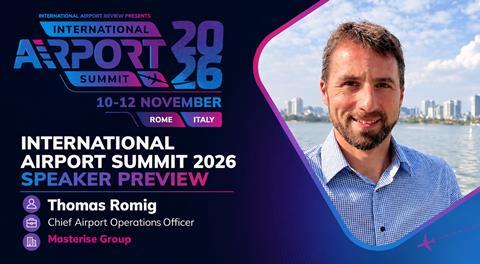
International Airport Summit 2026 speaker, Thomas Romig, Chief Airport Operations Officer of Masterise Group, explains why airports should focus on flexibility, energy capacity and future-proof infrastructure rather than trying to predict which aviation fuel will dominate.
Ask an airport planner what the aircraft fleet will run on in 2045, and you will get a range of answers and assumptions. Jet A-1, sustainable aviation fuel (SAF), hydrogen, and battery-electric propulsion will all play a part in that answer, but the proportions and usage will vary widely across the global regions. The challenge we are faced with, however, is that apron pavements, the fuel hydrant system, the fuel farm, the electrical substation and the available land around them are decisions we are making now, and they will still be in service long after the argument over the fuel mix has been settled.
Airlines cannot decarbonise without the appropriate fuels and necessary infrastructure being made available across the network of airports. Yet airports are being asked to plan for and, in some cases, provide these energy sources, ahead of firm demand, ahead of certainty about which fuel source wins, and often ahead of a regulatory framework that says who pays. Build too little, and you become the bottleneck in someone else’s climate plan; build the wrong thing and you are left with a stranded asset on a balance sheet that has to last 30 or 40 years. Looking at both mature European or North American hubs or emerging greenfield programmes in Southeast Asia and the Middle East, it is challenging to forecast the transition. The realistic task is to design for flexibility and scalability that will accommodate future fuel demands.
Future fuels do not arrive at the same time, or in the same way
It helps to be precise about what each pathway asks of an airport, because the temptation is to treat “future fuels” as a single problem, when it is really three problems on three different clocks.
SAF is the near-term reality and the easy one, relatively speaking. For the most part, it is a drop-in fuel that blends with conventional Jet A-1 and moves through the hydrant system that already exists. When Singapore Airlines and Neste inducted blended SAF into Changi’s hydrant network back in 2022, the achievement was operational and commercial rather than civil-engineering; the pipes were already in the ground. San Francisco International Airport showed the same principle at scale, moving SAF through the existing product pipeline rather than trucking it in. What SAF really demands is quality assurance and traceability, the certification discipline to keep book-and-claim honest, and enough tankage and supply contracts to meet mandates such as ReFuelEU Aviation, which began at a modest 2% in 2025 and climbs toward 70% by 2050. These are real obligations, but they largely bend existing systems rather than replace them.
Hydrogen changes the physics of the problem. Liquid hydrogen is cryogenic, low in volumetric energy density, and it does not slot into a hydrant system designed for kerosene. It brings new storage, new safety separation distances, new refuelling concepts, and a step-change in what the rescue and firefighting service must be trained in and equipped to handle. Pilots with hydrogen ground power units and hydrogen-fuelled airside vehicles are the right way to learn, but scaling from a contained small-scale trial to a full hydrogen-powered aircraft turnaround is a huge transition. The infrastructure requirements are not yet defined, and the operating model is still being drawn up. Many projects are looking at the development of aircraft techology supported by hydrogen, and only a few are looking at airport infrastructure and operations. In terms of forward planning, airports should be anticipating the use of hydrogen on their sites, but not pouring a liquid-hydrogen fuel farm today. That said, every airport should know where it would go in their masterplan.
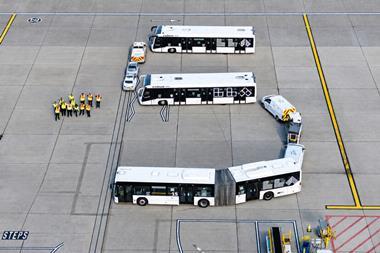
The third pathway, electrification, sits between the two and is the one already reshaping the apron. Ground support equipment is going electric fast, and that alone is quietly rewriting load calculations across the airfield. Behind it comes the prospect of regional electric and hybrid aircraft that would need megawatt-scale charging at the stand and the grid capacity to feed it. The production of aircraft at scale may be uncertain; the direction of electrical demand is not. States need to be anticipating this demand and scaling up their energy production capabilities as well as the grid distribution networks to facilitate the transport of energy as the demand increases. Aviation is moving towards more electrification, and all other industries are doing so simultaneously. This will create a serious power bottleneck if not anticipated appropriately.
An energy problem
If we combine the three energy pathways together, the pattern is hard to miss: the common constraint is not the fuel itself, but the energy production and distribution system, as well as the land needed for it. SAF needs tank storage and a huge increase in production and supply. Hydrogen, if produced or liquefied on or near an airport site, needs enormous volumes of (electric) power and water. Electric aircraft and an electrified apron need significant power grid headroom that many airports simply do not have today, especially those brownfield sites that are already power constrained. The ACI World and World Economic Forum’s work on “airports as energy hubs” makes the point well: “The airport in this energy transition is a node on the energy network first and a place to catch a flight second.”
As an airport operator developing a masterplan, this really matters because grid connections and available land are two of the things with the longest lead times and the least flexibility. An aircraft operator can defer a decision on the use of a specific fuel type, but you cannot conjure up a high-voltage connection or a parcel of safeguarded land at short notice. If there is one place to invest ahead of demand with confidence, it is in electrical capacity, in the cabins, the grid, ducts and corridors to distribute it, and in the spatial reservations that keep future development options open.
Design for options, not for forecasts
In this specific case, the most appropriate response is optioning rather than locking-in a single option, and a few principles hold regardless of which fuel prevails.
Safeguard land and utility corridors first – and safeguard generously. Reserving a footprint for a future hydrogen facility or a second grid intake costs comparatively little. Trying to retrofit one into a congested airfield later is exceedingly expensive, if it is possible at all. Stage the hard assets so that each phase earns its keep on its own and none forecloses the next; modular fuel infrastructure and multi-fuel stands are worth the premium because they buy the right to change your mind. Pursue the no-regret moves aggressively: develop grid headroom, on-site power generation and storage, a digital twin of the energy system, and training for a fire service that will one day face fuels it has never seen. Bring the airlines into the discussion to understand their needs and intentions. Establishing a shared and regularly revisited view of the transition with airline partners will ensure that the investment in these options will avoid putting the brake on airlines’ future choices.
A greenfield programme has a genuine advantage here. When you are drawing the masterplan on open ground, you can safeguard the hydrogen plot, size the electrical spine and reserve the pipeline corridors before a single stand is committed, at a fraction of the cost and disruption a mature hub would face doing the same. The corresponding risk is that a greenfield site requires you to design for an assumed demand profile and a fuel mix that is decades away. The key is to safeguard options and build only what the first phase truly needs.
Deciding late, on purpose
The primary challenge with all of these options is matching the timing of each decision to its lead time, that will meet the actual demand. Grid capacity and land: decide early, because they require land mass and can’t be recovered if you wait. Fuel-specific plant: decide late, because the technology, the economics and the mandates are still moving and we gain nothing by committing before we really must have them. The key lies in holding onto all of these options, even without a clear demand.
Airports that navigate this well won’t be the ones that guessed the future fuel demand profiles correctly. They will be the ones that built the capacity to serve whichever fuel is required by their customers, in whatever order they may need them, and that resisted the urge to stake the masterplan on a single fuel type.
I will be talking in-depth about this very topic at the International Airport Summit, taking place in Rome on 10-12 November 2026. Make sure you sign up for your complimentary ticket to ensure you are in the room for the discussion and to ask your questions of the panel.






No comments yet