
Airport Authority Hong Kong has deployed six Brushman robots to repaint runway markings, cutting session times and reducing physically demanding night-shift work for airfield staff.
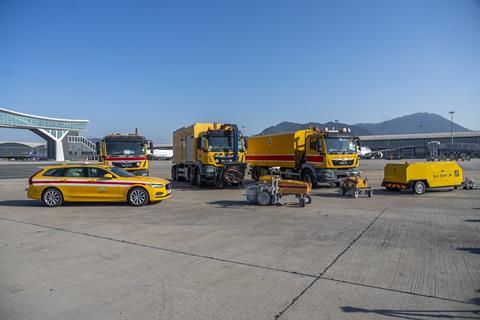
Hong Kong International Airport (HKG) has become the first airport in the world to deploy autonomous robots to repaint runway markings, introducing six Brushman robots to support its night-time maintenance programme.
Airport Authority Hong Kong (AAHK) developed and piloted the robots on its runways in collaboration with a technology company, a trial it said yielded excellent results. The deployment forms part of a wider effort by AAHK to progressively transition different airfield tasks to robots.
Faster repainting on closed runways
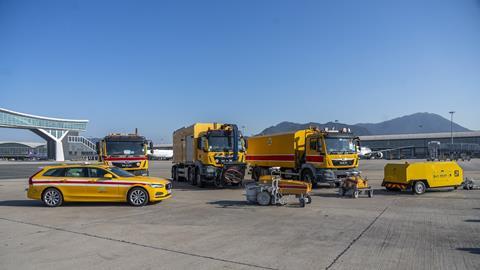
Hong Kong Airport handles a high volume of daily air traffic movements across three 3,800-metre runways, which are closed in rotation during late-night hours for routine maintenance. This work uses runway sweepers, rubber removal machines, the Airfield Ground Lighting Scanning and Inspection System (AGLSIS) and surface friction tester vehicles to keep runways free of foreign object debris, maintain clear markings and ensure airfield lighting is fully functional.
Runway lines and markings guide aircraft during take-off and landing and require repainting at intervals ranging from weekly to every six months.
Previously, repainting was labour-intensive and physically demanding, typically taking two to four hours per session and requiring around five to six airfield assistants per night shift. Traditional painting machines and pumps are noisy, meaning staff had to wear hearing protection and harnesses.
According to AAHK, Brushman can complete the repainting process in one to two hours. The robots operate quietly, are described as environmentally friendly and feature a low platform close to ground level, which simplifies paint refilling. The airport authority said this reduces the need for staff to carry out strenuous, repetitive work during night shifts, when deployment is most challenging, while lowering the risk of errors and workplace accidents.
The robots paint lines along a preset route on a closed runway, monitored by an on-site operator who can intervene via remote control or replenish paint when necessary. This allows staff to be redeployed flexibly to other roles.
For positioning, the robots use Real-Time Kinematic (RTK) technology based on global navigation satellite systems, integrating data from four major satellite systems. They also detect obstacles in real time and halt to avoid collisions, meeting the stringent safety requirements of runway operations.
The introduction of Brushman adds to AAHK’s existing fleet of driverless vehicles at Hong Kong, which includes 56 autonomous tractors, eight autonomous staff shuttle buses and six autonomous patrol vehicles.

No comments yet