
Speakers in Rome argued that airport capacity will come from better use of people, data and existing assets, from CT security to AI baggage planning.
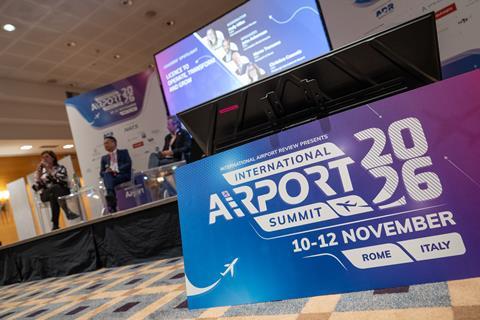
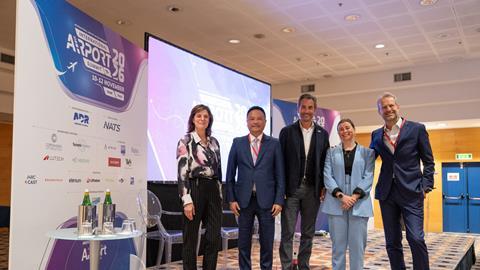
Day one of International Airport Summit (IAS) 2026 kept returning to a single idea: the next wave of airport capacity will come from better use of people, data and existing assets, not from concrete alone. With Aeroporti di Roma (ADR) as Airport Partner, the programme moved from boardroom strategy to the checkpoint, the baggage hall and the apron. Across every session, speakers agreed that technology only delivers when the processes and frontline teams around it change too.
Airport leaders put people before projects
Following the opening keynote interview with ADR CEO Marco Troncone, leaders from Los Angeles, Pittsburgh, Hong Kong and Rome compared notes on transformation. John Ackerman, CEO of Los Angeles World Airports, said LAX sat at the bottom of its category for passenger satisfaction three years ago and has since launched more than 60 projects worth $6 billion. The more important work, he argued, is rebuilding the training, tools and systems its staff rely on. “If we can take care of our people, they can take care of our customers,” he said.
Christina Cassotis, CEO of Pittsburgh International Airport, set out how the airport built a new terminal while running the old one. Its chief operations officer had the power to halt construction work, frontline staff tested materials before they were specified and 55 trials were run before opening day. “We had our painters pick the paint and the architects approved the colour,” she said. Around 90 per cent of materials were sourced locally.
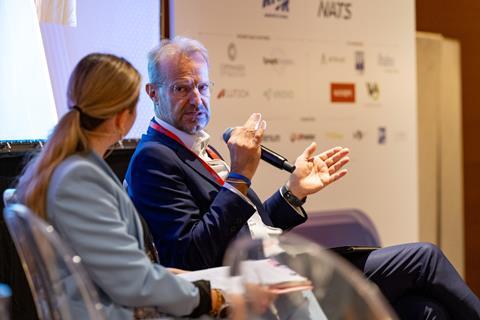
William Ho, Executive Director, Corporate Development at Hong Kong International Airport, explained how the Skytopia airport city is designed to turn the airport into a destination in its own right as it prepares for 120 million passengers by 2035. Commercial income, close to 60 per cent of revenue, is central to funding that capacity. Troncone described a future Fiumicino that leans far more heavily on technology while keeping people, and a Roman sense of place, at its centre.
Smoother flow in constrained terminals
This session examined how spatial intelligence can ease pressure in terminals that cannot easily expand. Outsight co-founder Raul Bravo explained how 3D sensors give every passenger an anonymous unique ID, allowing airports to follow flows, queues and dwell times in real time. Moderator István Szabó, Managing Director and Chief Operating Officer at Berlin Brandenburg Airport, cautioned that “it’s not enough to flood the system with data” without staff and processes able to act on it.
Roberto Formica, Head of Quality & Customer Experience at ADR, said new systems have to be validated against reality before anyone relies on them. “I do manual checks. That’s the only way in my opinion,” he said. At Fiumicino, the technology now informs when to open security lanes and how to manage crowding airside, and is helping retailers understand how passengers on different flights behave.
Building the data foundation for prediction
Panellists argued that prediction depends on trust in shared data long before it depends on AI. Giovanni Russo, Chief Operating Officer at Geneva Airport, said AI tools now produce more reliable passenger forecasts three to 12 months ahead than traditional methods based on slots and load factors. But a single source of truth is only as good as what partners put into it, and he warned that financial incentives between airport stakeholders can work against accurate data. “Things start with people talking together and understand each other’s business,” he said.
Steve Anderson, Head of Future Airport Operations at NATS, pointed to Heathrow’s handling of airspace restrictions during the Queen’s funeral in 2022, when scenario modelling let airlines reshape schedules in advance. His advice to airports with fragmented systems was to start with the decision that needs to be made, then work out who needs what information and when.
CT security is more than a technology swap
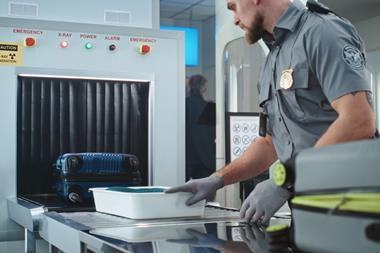
Moderated by Stacey Lora of JFK International Air Terminal, the security panel was frank about what CT deployment demands. Leeds Bradford Airport’s Keith Moran described fitting new lanes around the support columns of an ageing building, with less queuing space and far greater cooling needs than expected, before a new central search area opened as part of the £100 million LBA:REGEN programme.
Hamad AlZayani of Bahrain Airport Company said his team measures images per passenger, not trays alone, and found that screeners were initially rejecting too many bags until trainers spent hours on the floor explaining the technology. On automated threat detection he was clear: “I think that the AI should be an assistant, not the decision-making tool.”
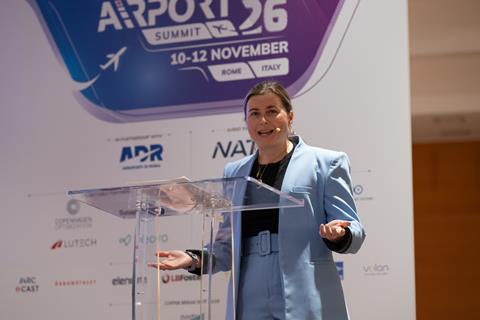
Dr Jan-Henrik Andersson, Chief Commercial and Security Officer at Munich Airport, said the airport leapfrogged directly to C3 and has built a culture of learning from early failures. “If you treat the screening process just as a mere technology replacement, you will fail,” he said, urging airports to redesign the whole process around the guest.
The airport as a country’s first handshake
In conversation with International Airport Review, Joaquín Franco, Vice President of Airport Services and Passenger Experience at Tocumen International Airport, showed how observing passengers has shaped services at a hub where around three-quarters of travellers are in transit. Sala Panamá, an interactive space in the connector between Terminals 1 and 2, has drawn more than 200,000 visitors since it opened in May and has turned a stressful walkway into a showcase for the country. A sensory room, pet relief area and weekly cultural events have followed. Franco said he sees the airport “as the first handshake” between Panama and its visitors.
Finding hidden capacity with AI
The innovation showcase offered two examples of AI in live operations. Samuel í Hjøllum Rude of Copenhagen Airport said passenger numbers are expected to reach around 34.5 million this year, yet the site leaves little room to build. Treating baggage make-up allocation as “more like a mathematical problem”, the airport uses machine learning and optimisation to plan positions each day and expects 10 to 20 per cent more capacity. His advice to peers was to “look for the hidden capacity” before adding physical infrastructure.
Emanuele Calà, Senior Vice President Transformation and Technology at ADR, outlined how AI-based turnaround monitoring moved from proof of concept in 2023 to deployment across 57 gates, covering more than 75 per cent of turnarounds at Fiumicino, with data shared across airlines and handlers. Every proof of concept, he explained, starts with agreed KPIs so the business case for rollout can be made. Miami International Airport’s Maurice Jenkins then opened the AI panel with a show of hands: plenty had been told AI will change everything, almost none would let it run their airport alone.
Power resilience as a licence to grow
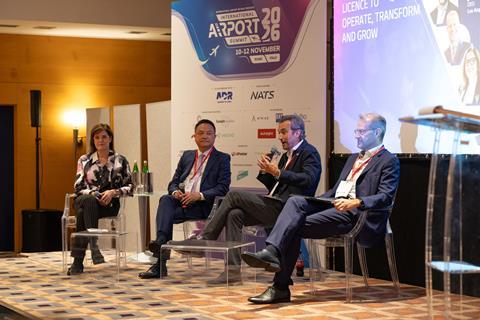
The closing fireside chat linked decarbonisation to competitiveness. Giampiero Goretti, Head of Energy Management and Decarbonisation at ADR, said airports have shifted from energy customers to producers and distributors. Fiumicino now has a 22MWp solar farm beside its third runway, storage built from 762 second-life vehicle batteries and more than 400 charging points. “I think that resilience could be a licence to grow,” he said.
Johannes Huber, CEO of Forbo Group, said that baggage conveyors rank among an airport’s top five energy consumers, and that low-friction belts can cut that demand by 20 to 50 per cent, paying back within one to two years. “Our belts make you money,” he said.
The message from day one was consistent: the capacity, resilience and passenger satisfaction airports need over the next decade are already within reach for those willing to rethink how their people, partners and data work together.
No comments yet