

Rising passenger numbers and capacity pressures are accelerating a shift towards smarter, more automated baggage systems as airports adopt robotics, data intelligence and modular screening to strengthen resilience, safety and operational efficiency.
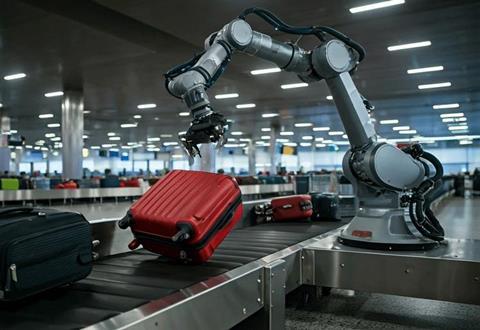
Airports are rapidly rethinking their baggage operations as smart technology, robotics and data‑driven decision-making move from experimental trials to live operational environments.
Speaking at the International Airport Summit, experts from Aena, Brussels Airport, BEUMER Group and Smiths Detection outlined how automation, process redesign and intelligence‑led maintenance are reshaping baggage systems to meet growing passenger volumes and rising expectations.
Moderator Alvaro Rios, Innovation Project Manager at Aena, set the tone by calling innovation “essential to ensure resilience, efficiency and passenger trust,” as the sector faces higher complexity and workforce shortages.
Robotics and process redesign are converging to transform baggage operations
Across the industry, the strongest innovation trend is the convergence of robotisation with process change, according to BEUMER Group’s Business Development Director, Per Engelbrechtsen. Airports such as Oslo, Heathrow and Brussels are now modelling their operations more like logistics hubs, shifting towards batch building, parallel processes and automated loading.
Engelbrechtsen said robots are beginning to address one of baggage handling’s most persistent challenges: repetitive heavy lifting. “We see robotisation shaping how airports operate. It replaces many manual lifts and can be a game changer,” he said.
A major milestone is approaching in early 2026, when BEUMER will launch a live pilot using autonomous robots inside a European airport. This comes alongside innovations such as Beumer’s ECAC‑approved parallel processing concept, which can reduce scanner volumes and workforce requirements by up to 50%.
Semi‑automated loading is shifting the mindset at Brussels Airport
Brussels Airport has already deployed its first semi‑automated loading stations, allowing machines to lift bags into carts. For Head of Baggage, Yorick Buys, the technology is only half the story: success hinges on changing the operating model.
Traditional baggage halls operate with hundreds of dedicated chutes and long open windows for sorting. Automation forces a rethink. “If I tried to implement 250 loading devices, it would be impossible,” Buys said. “But if we change the process, we make life easier for handlers and create a win‑win.”
Staff buy‑in increased once teams saw they could avoid manual lifting. Transitioning from loaders to robot operators is also seen as a future skills upgrade, not a threat.
Screening suppliers focus on modularity, speed and reducing false alarms
Innovation is also accelerating in the screening environment. Smiths Detection is targeting the pressure airports face to integrate large EDS machines into constrained, decades‑old baggage halls. Director for Aviation and Critical Infrastructure, Dr Jürgen Kappler, said modular design is now essential for upgrading brownfield sites without major disruption.
He added that detection systems must simultaneously address two competing trends: increasing threat volumes and the demand for higher throughput. Each new threat type increases algorithmic complexity and risks slowing down operations.
“False alarm rates are a key bottleneck,” Kappler said. Smiths Detection is focusing on reducing no‑scan events, narrowing bag spacing and integrating new technologies such as diffraction to support higher belt speeds.
Kappler also highlighted the need for strong collaboration between airports, original equipment manufacturers and system integrators to ensure screening data, interfaces and operational requirements are aligned from the outset.

Data intelligence is enabling early warnings and avoiding major disruptions
Airports are making significant progress in using machine data, operational logs and predictive insights to avoid unplanned outages.
Engelbrechtsen described how Oslo Airport has moved beyond data collection to implementing feedback‑loop intelligence. Maintenance staff now receive daily notifications on which components show abnormal behaviour, targeting only a handful of assets out of thousands.
While the system does not yet diagnose exact failures, it identifies suspicious patterns that help engineers intervene early. “It is very beneficial today just to know which five elements to look at. That saves a lot of time,” Engelbrechtsen said.
Buys noted that even a 15–20 minute technical failure can create a three‑to‑four hour check‑in disruption. Faster detection, powered by live machine data, has dramatically reduced the number of issues escalating into system shutdowns.
Automation strengthening resilience

Airports increasingly view automation as a resilience tool, not a risk factor. With most medium and large airports already depending on automated sorting, the risk profile has shifted.
Buys explained that major disruptions typically result from system‑wide failures, which require manual fallback processes regardless of whether robotics are in use. In contrast, failures of individual robots or loading devices can be mitigated through redundancy, such as spare units or duplicate feed lines.
“Automation does not add much extra risk,” he said. “It is about having enough redundancy built in, just as we do with screening machines.”
Human expertise remains essential
All panellists agreed that humans must remain central to future baggage operations. Automation will replace heavy lifting and high‑volume repetitive tasks, but airports will continue to rely on staff for judgment, edge cases and customer interaction.
Engelbrechtsen argued that removing humans entirely risks “dehumanising the airport journey” at a time when passengers increasingly value personal service. Automation should allow more staff to be redeployed into passenger‑facing roles.
Buys added that human‑in‑the‑loop control allows airports to avoid over‑engineering for every edge case. Staff remain essential for troubleshooting complex baggage types and overseeing robotic workflows.
Kappler echoed this from a security perspective. Algorithms excel at repetitive threat identification but rely on human operators for false alarm resolution and broader risk assessment.
Cultural change and early collaboration
Despite technological progress, the biggest barrier to scaling automation is people. Engelbrechtsen warned that without staff engagement, expensive lifting devices risk becoming “an expensive coffee table.”
Successful airports, he said, bring handlers, airlines and unions into the design process early, helping them understand that automation enhances rather than replaces roles.
Airports that frame the shift as a move towards higher‑skill, safer jobs rather than job loss are progressing fastest.
A more connected future
Across the session, the message was clear: the baggage handling system of the future will be more autonomous, more data‑driven and more modular, but will still rely on human insight to guide operations.
With passenger numbers set to double again over the next 15 years, panellists agreed that expanding the workforce is not feasible. Automation, robotics and intelligent systems will be essential to keeping pace with demand while maintaining safety, service quality and operational resilience.
Baggage transformation is a topic that was explored in greater depth in International Airport Review’s ‘Scaling baggage innovation for operational resilience’ webinar which took place on 20 May, featuring speakers from Schiphol, Kuala Lumpur and Queen Beatrix International Airport in Aruba. To watch the webinar on-demand click here to register.
We have also recently published our Baggage Innovation eReport. Click here to download the FREE eReport now.






No comments yet