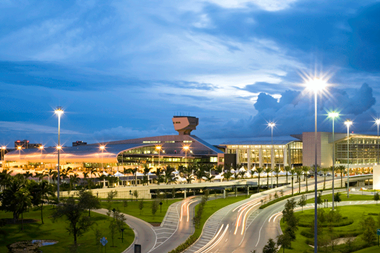




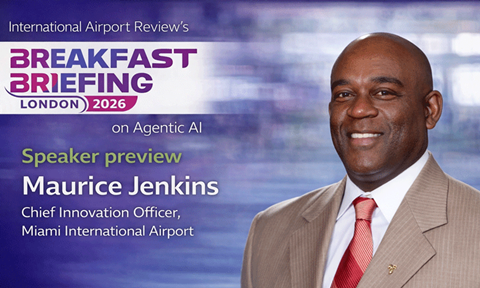
The Miami-Dade Aviation Department (MDAD) Environmental team at Miami International Airport has been testing an environmental AI capability and is now moving it from a test/proof-of-concept into a production-ready “AI document search and chat” experience. Maurice Jenkins, Chief Innovation officer of Miami International Airport and Jeremy Mathurin, Director of Work Force Solutions at Microsoft, explain more.
Business challenge and proposed solution
The Miami-Dade Aviation Department (MDAD) manages a large and continuously growing set of PDF-based documents that support operations, compliance, and decision-making. Current methods make it difficult to efficiently search across both historical and newly added documents, which increases manual effort and can delay access to accurate information. After a successful proof-of-concept, MDAD is currently in the process of implementing the security, scalability, and operational components of this solution – Miami Internal Airport’s first generative AI solution!
The initiative delivers a cloud-based architecture on Microsoft Azure that ingests MDAD’s environmental PDFs, extracts their content (including complex tables), enriches the content with metadata, and makes it searchable through a conversational chat interface. The solution was architected such that AI-generated answers are grounded in the underlying documents and include citations back to source files – so users can verify and trust what they are seeing.
From ingestion to answers: the end-to-end AI document search journey
MDAD’s AI-enabled environmental document management system begins by iteratively ingesting PDF documents from MDAD’s secure cloud storage, updating regularly to include both older and newly added files. This recursive process ensures that all documents past, present and future, are available for search and reference. Next, the system uses Microsoft’s advanced document processing tools to turn these PDFs into a text format that keeps important layouts and tables, making the information easier to use and more complete than simple scanning.
They can ask questions in everyday language, and the system responds with answers drawn directly from the indexed documents.
After the text is prepared, the system adds helpful tags and details (metadata) such as dates, locations, and facility names using Microsoft’s language analysis tools. These enhancements make it much easier to find the right information quickly. The enriched content is then organised and indexed, so the system can search through large volumes of documents efficiently using smart search techniques that combine traditional and AI-powered methods.
Finally, users interact with the system through a simple chat interface. They can ask questions in everyday language, and the system responds with answers drawn directly from the indexed documents. Each answer includes a link back to the original document, allowing users to verify the information for themselves.
Revolutionising environmental compliance: outcomes
The project is designed to reduce staff time spent manually searching and validating documents, increase confidence through AI-grounded retrieval with citations, and mitigate risk through secure access controls. It also establishes a scalable architecture intended to support growth in document volume without proportional increases in operational burden, while creating a foundation for future AI enhancements. Separately, the initiative has clear “real-world” execution signals: stakeholders are co-ordinating procurement and security review, a Remedy ticket has been created to initiate the work with appropriate IT and cyber-security involvement, and the implementation is explicitly framed as moving from POC to production readiness.
Beyond the immediate environmental compliance use case, this project is forward-thinking because it introduces a repeatable, “AI-ready” pattern for airport operations: secure ingestion of operational records, governed indexing, and retrieval-augmented responses that remain traceable to authoritative sources. By proving that generative AI can be deployed with enterprise controls (security review, access governance, auditability, and production scalability), MDAD is establishing a blueprint that can be extended to other high-impact operational domains such as maintenance history lookups, incident and inspection support, permitting workflows, and cross-department knowledge sharing. In doing so, the initiative advances AI at Miami International Airport from experimentation to an operational capability that improves decision speed and consistency while maintaining trust and compliance.
Next steps
Once in production, the system is intended to operate as a living capability, processing ongoing updates (including weekly document updates) while maintaining searchability across the full historical record and returning cited answers users can validate. Advanced capabilities such as document redaction, image understanding, workflow automation, or multi-agent reasoning are out of scope for this phase and could be considered in later phases.
Maurice is speaking at International Airport Review’s breakfast briefing taking place on 18 March 2026 at Crowne Plaza, London Docklands by IHG, register now to attend and ask him your questions around launching agentic AI at your airport.