
Ahead of his participation at PTE World in London, Fabrizio Magliocca, Director of Business Transformation, Innovation & Quality at Aeroporti di Roma shares how quality management, AI, predictive operations and sustainability are shaping a more connected, people-centric and resilient airport model for the decade ahead.
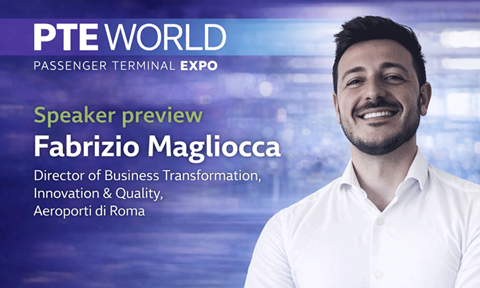
What are the key priorities driving Aeroporti di Roma’s transformation strategy over the next five years?
Over the next five years our transformation strategy is about building on our solid traffic growth while positioning Rome’s airports for long‑term competitiveness and relevance. After reaching over 50 million passengers last year, it is clear that growth itself is not the objective, but the context in which we must evolve our operating model and services.
Our focus is on shaping an airport that is more predictive, connected and people‑centric. We want passengers to experience a journey that feels effortless and personalised at every touchpoint, from real‑time flight updates and assistance tools to seamless navigation through terminals. Technological innovation like AI‑enabled assistants supports this ambition, but always within an operational framework that prioritises reliability and consistency.
At the same time, we are reinforcing our infrastructure and internal processes to become an even more efficient and adaptable hub, able to orchestrate complex operations while generating economic and social value for the region. Sustainability is not an add‑on but a core principle, guiding every stage from planning to delivery. We embed environmental goals into infrastructure, operations and services to make the airport an integral part of a broader, more sustainable transport ecosystem.
Ultimately, our strategy is about transforming ADR from a traditional airport operator into a smart hub where innovation, customer experience and long‑term resilience come together in service of passengers, partners and the community.
What role does quality management play in shaping your transformation roadmap?
Quality management plays a central role in how we make decisions at Aeroporti di Roma and is one of the key drivers of our transformation roadmap. We use quality not only to assess results, but to guide choices across the organisation, from very practical decisions such as defining the most effective passenger signage, to more strategic ones like selecting the technologies that best respond to specific operational and customer needs.
What distinguishes our approach is that innovation, transformation and quality are managed within the same team. This allows us to maintain full control of the process end-to-end, from scouting and testing new solutions, to deploying them at scale, and finally evaluating their impact on passengers and airline partners.
This integrated model helps us avoid isolated initiatives or technology driven projects. Every solution is assessed through a quality lens to ensure it delivers measurable value and a consistent experience before being scaled across the airport. As a result, we are able to innovate quickly while maintaining reliability and coherence across a highly complex operating environment.
Which emerging technologies do you believe will have the greatest impact on airport operations in the next decade?
AI and computer vision will continue to transform real time operations by improving situational awareness and predictability. Autonomous and semi-autonomous systems will increasingly support operational decision making in specific domains. Digital twins, connected to live data, will shift planning and operations from reactive to predictive.
At the same time, autonomous operations represent a potentially disruptive opportunity for the industry. While full autonomy will require a longer time horizon, early applications in controlled operational domains are already emerging. These use cases are important because they allow airports to build experience, adapt processes and prepare the organisation for a more autonomous operating model in the future.
More in general, the real impact will not come from individual technologies, but from how effectively airports integrate them into daily operational processes and decision loops.
Is ADR using agentic AI? If so, where is it having the biggest impact?
At the moment, our use of agentic AI at Aeroporti di Roma is mainly focused on enterprise and corporate processes, where automation of repetitive workflows can deliver tangible efficiency gain while also supporting decision making, co-ordination and efficiency in a controlled environment.
Our objective, however, is to progressively reach a level of maturity that will allow us to extend these applications to operational processes as well. This requires ensuring that agentic AI can operate in full alignment with the high standards of security, safety, compliance and quality that are already embedded in our current operating processes.
For us, this is a gradual and deliberate journey. As confidence, governance and reliability increase, agentic AI can become a powerful enabler also in operations, while preserving the robustness and consistency that are essential in an airport environment.
Discover how agentic AI is revolutionising airport operations at International Airport Review’s Breakfast Briefing on 18 March at the Crowne Plaza, London Docklands.
Which technologies will have the biggest impact on operational efficiency for airports in the next two to three years?
In the next two to three years, the biggest impact on operational efficiency will come from technologies that are already mature enough to be deployed at scale. These include AI-driven forecasting and resource planning, computer vision applied to airside operations and turnaround optimisation, and more integrated operational platforms enhanced with predictive analytics. Further automation of repetitive processes will remain a key lever for improving efficiency in the short-term.
What challenges do you face when integrating new technologies with legacy systems?
Integrating new technologies with legacy systems is not only a technical challenge, but also a process related one. Many legacy systems were designed to guarantee very high levels of reliability and continuity, which remain essential in an airport environment.
Introducing new technologies often requires a review and evolution of existing processes. At ADR, this work is led by the transformation team, which operates in close collaboration with the business lines to ensure that new solutions are embedded into day-to-day activities in a coherent and effective way. Simply adding new tools on top of established ways of working rarely delivers real value.
Timing is another critical factor. New technologies need to be integrated when they are sufficiently mature to operate at scale and meet the reliability standards required in complex operations. Choosing the right moment also creates economic value, as the same technology can have very different cost and return profiles over time. The objective is to balance innovation, robustness and value, ensuring that new solutions are adopted when they are ready to deliver consistent performance and sustainable benefits.
What will your focus be at PTE? What are you there to talk about/present on?
At PTE, I will focus on how AI‑powered solutions are transforming the way airports collect and use real‑time data to make operations more efficient and predictable. I will share examples of how advanced analytics and AI can anticipate critical events, support better planning, and enable smoother ground operations.
The discussion will highlight how AI‑generated data can be integrated into collaborative workflows to improve resource allocation, operational predictability, and the passenger experience. We will also explore how these technologies can strengthen collaboration across the airport ecosystem, helping stakeholders work together more effectively.
What are you looking forward to learning from other airports at PTE?
What I find most valuable at PTE is the opportunity to understand how other airports are dealing with complexity at scale. Beyond individual technologies, I am interested in how peers are making structural choices that allow innovation to move from pilots to everyday operations without increasing fragility in the system.
I am particularly keen to learn how airports are aligning technology, processes and governance, especially when multiple stakeholders are involved. Topics such as how data and AI are governed across the airport ecosystem, how accountability is defined, and how real impact is measured over time are highly relevant for us. These conversations, grounded in real experience rather than theory, are what truly help refine and strengthen our transformation approach at ADR.
Fabrizio is speaking on the below session at PTE World:
‘Harnessing AI-driven insights to optimise POBT and enhance A-CDM collaboration’
18 March 2026 13:45-14:30 GMT