





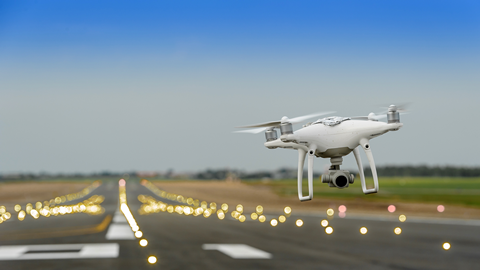
In this interview with International Airport Review, Stijn De Vleeschhouwer, Managing Director of SkeyDrone explains why relying solely on detection technology is a dangerous misconception.
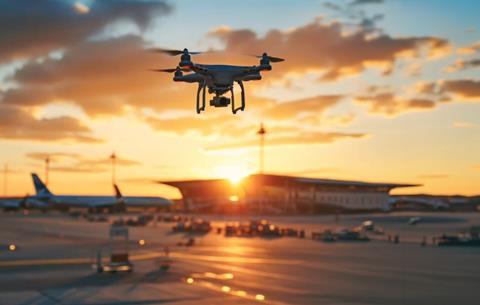
In recent years, airports worldwide have faced a rapidly escalating challenge that threatens to disrupt the very core of their operations: unauthorised drone activity. Between 2024 and 2025 alone, the aviation industry witnessed a staggering 400% increase in drone-related incidents. Even unverified reports of drone sightings have the power to trigger runway closures, cascade into severe flight delays, and result in costly aircraft diversions.
To understand how airports can navigate this complex and evolving threat landscape, International Airport Review sat down with Stijn De Vleeschhouwer, Managing Director of SkeyDrone, to discuss where counter-drone measures fit into a wider airport security strategy and what critical steps the industry must take next.
The evolving threat landscape
The nature of the drone threat is undeniably shifting. What began primarily as a nuisance caused by hobbyists unknowingly flying their devices into restricted airspace has taken on a more serious, sometimes state-sponsored dimension. Recent incidents, such as a suspected Ukrainian drone being rerouted into the airspace of Vilnius Airport in Lithuania, highlight how geopolitical volatility is increasingly bleeding into civilian aviation.
Yet, for Stijn, the origin of the drone matters less than the airport’s underlying capability to manage the airspace. “Whether it’s a military context or not, where the drone is appearing in an airport, it doesn’t matter,” he explains. “As an airport, you need to be able to secure yourself and you need to be able to respond in a proper way towards the situation that is occurring.” The consistently rising use of drones necessitates that airports are fully prepared with the necessary tools and procedures to take the right actions.
The three pillars of incident response
When a live drone incident occurs, the pressure on airport operations teams is immense. Stijn outlines three critical, operational priorities that airports must immediately focus on during an incursion.
“When it comes to prioritising, I think the first priority is understanding whether the drone is actually a threat at that moment,” he states, noting that airports must first quickly determine if the object is indeed a drone and whether it conflicts with planned airport operations.
The second priority is speed of action. “In cases where there is an acute safety or security risk, predefined procedures would start and should be executed so that there is protection of the ongoing surrounding operations,” Stijn advises.
The third priority revolves around continuous and rigorous data collection. Managing an ongoing threat requires gathering and refining information as the situation actively evolves. Stijn emphasises that validating this data supports both the immediate threat assessment and the subsequent operational responses. He highlights the gravity of this continuous data collection by noting the challenges of recovery: “Imagine you close the airport, which is the worst situation. What do you need to know to be able to open the airport again? Because that’s a much more difficult decision to take than closing the airport.”
Beyond the hardware: the need for context
A recurring theme in Stijn’s philosophy is that technological detection alone is vastly insufficient. He strongly warns against treating counter-UAS (unmanned aircraft systems) as an isolated technical capability.
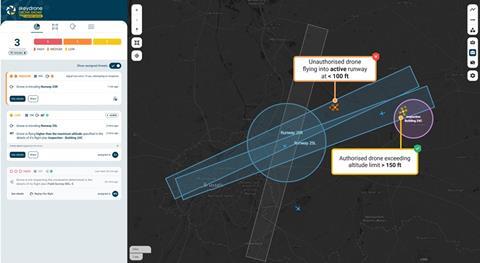
“A drone detection on its own actually does not say a lot,” he notes. “It only becomes useful when you combine that information with context, any incident history that you have, input from law enforcement, and having a real-time airspace view on the activities.”
While airports are investing heavily in hardware, moving beyond just radio frequency (RF) sensors to include radar, cameras, and sometimes acoustic sensors to detect drones actively trying to evade RF detection, this multi-layered technological approach must be paired with operational context.
Stijn points out that hardware detection must be combined with unmanned traffic management (UTM) data to determine if a drone is legally authorised to fly in that airspace, and threat assessments must be driven by software that takes active runways into account.
“If drone-related information is handled outside of these established structures, it risks slowing down the decision making and creating inconsistency,” he warns. Effective integration ensures all stakeholders share a common operational picture, resulting in co-ordinated and timely responses. Ultimately, the goal is to “shift the focus from reacting to individual alerts to anticipating and managing the risk proactively within a framework that is already trusted and operationally embedded.”
The critical role of CONOPS
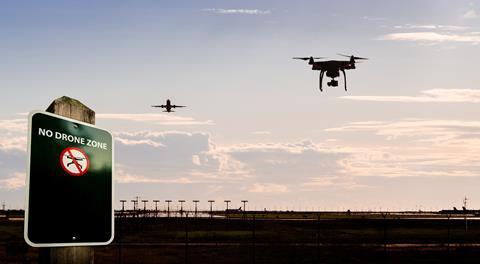
To successfully balance safety, operational continuity, and regulatory compliance, Stijn champions the implementation of a well-defined Concept of Operations (CONOPS).
“CONOPS provides a structured framework that defines how drone incidents need to be assessed, who is responsible for the decision making and which actions should be taken under specific circumstances,” he explains. This ensures that responses are “consistent, proportional, linked to the threat and compliance” rather than being an improvised action taken under intense pressure. In split-second scenarios where an acute threat emerges, these predefined procedures ensure immediate execution to protect aircraft and operations.
As for how often a CONOPS plan should be reviewed, Stijn emphasises that this is primarily driven by changing circumstances rather than fixed timelines. Reviews are typically triggered when conditions differ from initial assumptions, for example, shifts in drone technology or operator behaviour, a higher volume of detections than anticipated, or changes resulting from awareness campaigns.
Lessons from recent disruptions
Recent high-profile drone incidents across Europe in October and November have served as a wake-up call for the industry. According to Stijn, these events revealed a distinct pattern: “uncertainty drives the disruption.” Often, airports suspended operations not due to confirmed malicious drone activity, but out of an abundance of caution resulting from a lack of concrete evidence.
“The real problem is not only the drone itself, it’s the ability to confirm or dismiss a threat quickly… as long as doubts remains, disruption is likely.” He points out that shutting down an entire airport every time there is a moment of uncertainty is no longer sustainable given the rapid increase in overall drone activity.
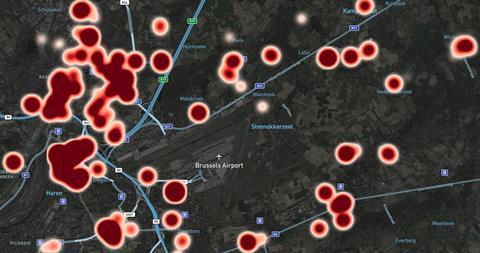
At Brussels Airport, for example, around 10,000 drone detections were recorded in controlled airspace in 2025, yet fewer than 10% represented a potential operational threat. This illustrates the need to distinguish between presence and actual risk.
Consequently, progressive airports are shifting away from reactive crisis management toward “more structured, risk-based response protocols where actions are pre-defined and linked to specific scenarios,” aiming to keep essential airport operations running.
According to Stijn, the challenge is no longer technological readiness, but Europe’s ability to execute at speed. While the threat landscape evolves rapidly and the urgency to act is widely recognised, implementation timelines across Europe remain slowed by fragmented regulation, complex procurement structures and lengthy decision-making processes. He believes Europe has the potential to lead globally, but only if it matches its innovation strength with faster operational execution.
The danger of active countermeasures
As the aviation sector matures in its approach to this threat, Stijn believes several major industry misconceptions must be urgently debunked. The first is the pervasive belief that simply purchasing the most advanced hardware will solve the problem. “In reality, no single sensor provides complete coverage and detection alone does not answer the operational question,” he asserts.
The second major gap is the failure to differentiate risk. “The tendency to treat all drones as equal threats” consistently leads to “overly conservative responses and unnecessary disruption,” he says. He strongly advocates for the recognition that most drone activity is not inherently malicious, requiring measured management rather than panic.
Finally, there is a significant gap in operationalising these detection systems. Many airports possess basic detection capabilities but thoroughly lack the necessary tools and the CONOPS required to “translate data into consistent decisions.” The future of airport security, therefore, is not necessarily about acquiring more hardware, but about achieving “better use of the information” to protect both physical safety and operational continuity. This translation of data into actionable decisions is exactly the capability SkeyDrone aims to support.
Looking ahead
For airports navigating the complex, crowded skies of tomorrow, the overarching message from SkeyDrone is that detection is merely the first, basic step. To truly safeguard operations against the rising tide of drone activity, a holistic, deeply integrated, and risk-differentiated approach is required.
As Stijn definitively summarises his final piece of advice for the aviation industry: “Please go beyond detection… it’s a threat assessment that will support you to take the right decisions, and that is crucial.”
About the author

Stijn De Vleeschhouwer is Managing Director of SkeyDrone, where he is responsible for creating market focus and preparing the organisation for international scaling.
With more than 15 years of experience in strategy, business development and organisational transformation, he supports technology companies through critical growth phases towards scalability and market impact.
Previously, as General Manager, he led the international growth of Televic Education (SaaS), achieving consistent double-digit growth. As Head of Sales & Marketing at Superlinear, he built governance, team structure and strategic focus to enable sustainable expansion. Today, he combines operational drive with strategic leadership to position SkeyDrone as a scalable European drone intelligence platform.
He is known as a no-nonsense leader who helps organisations accelerate towards focus, structure and growth.
Topics
Airport security in a geopolitically complex world

As geopolitical instability, cyber threats and insider risks reshape aviation security, this report explores why airports must move beyond perimeter protection towards integrated resilience, combining technology, governance and human oversight to withstand disruption and recover rapidly.
- 1
- 2
- 3
- 4
 Currently
reading
Managing the skies: Moving beyond detection in the age of drone disruptions [5]
- 6
- 7
- 8









No comments yet