
Ahead of International Airport Review’s breakfast briefing taking place in London during PTE on 18 March, Jordi Valls, Global Director, SITA Labs discusses how agentic AI can turn fragmented tools into goal-driven airport operations, provided data foundations, governance and human oversight are in place.
Agentic AI is being described as a revolution for airport operations. In your view, what makes it fundamentally different from traditional AI approaches airports have experimented with so far?
Traditional airport AI has mostly been predictive or assistive with forecasts, dashboards and alerts. Agentic AI goes a step further by reasoning across objectives, constraints and roles, then proposing or executing co-ordinated actions. It doesn’t just say “a delay is likely”; it can evaluate options, understand trade-offs, and orchestrate responses across systems and teams. The shift is from point solutions to goal-driven behaviour. That’s a material change in how operations are supported, especially in complex, time-critical environments like airports.
How close are we to achieving ‘total airport autonomy’, and what role will agentic AI play in bridging that gap?
Full autonomy is still far off, and likely not even the right goal. Airports are socio-technical systems with regulation, unions and safety constraints. What’s close is partial autonomy in defined operational domains: disruption handling, resource reallocation, or co-ordination tasks. Agentic AI will act as the connective tissue, handling cross-domain reasoning and time pressure while humans retain authority. The real progress over the next decade will be measured in reduced friction and faster recovery, not fully unmanned operations.
Why is a unified operational data architecture the non-negotiable foundation for agentic AI deployment? What risks do airports face if they skip this step?
Agentic AI depends on shared context: consistent flight states, resource availability, passenger flows, and constraints. Without a unified data architecture, agents reason on partial or conflicting truths, which is dangerous in safety-critical operations. Airports that skip this step risk brittle automation, silent errors, and loss of trust from operators. A common operational data layer isn’t about centralisation, it’s about alignment. Without it, agentic systems amplify fragmentation rather than resolve it.
Which airport pain points, such as disruption recovery or baggage exceptions, stand to benefit most from agentic AI in the next 12 months?
Disruption recovery, turnaround co-ordination and baggage exceptions are prime candidates. These areas are already data-rich but decision-poor under pressure. Agentic AI can synthesise inputs from airlines, ground handlers and airport ops to suggest prioritised actions in real time. The near-term value isn’t radical automation, it’s reducing co-ordination latency, minimising cascading delays, and helping teams converge faster on ‘good enough’ decisions when perfect information doesn’t exist.
Can you share an example of how agentic AI could transform turnaround co-ordination during peak disruption scenarios?
During a weather disruption, agentic AI can continuously re-evaluate aircraft priority, crew legality, gate availability, and passenger connections. Instead of static plans, it proposes rolling adjustments: swap gates, re-sequence services, alert specific teams, and flag trade-offs, to supervisors. Humans approve or override, but the cognitive load drops dramatically. The result is fewer missed handoffs, less radio traffic, and faster stabilisation, especially when dozens of flights are affected simultaneously.
Passenger experience is often the ultimate metric. How does agentic AI tangibly improve the journey for travellers while maintaining operational resilience?
Indirectly, but powerfully. When operations stabilise faster, passengers feel it as fewer missed connections, clearer information, and more predictable journeys. Agentic AI can also align operational decisions with passenger impact, prioritising flights with high connection risk or vulnerable passengers. The key is that experience improves not through flashy front-end features, but by reducing operational chaos behind the scenes. Reliability is still the strongest driver of passenger satisfaction.
Human-AI teaming is a recurring theme. How do you ensure that agentic AI augments rather than replaces human decision-making?
By design. Agentic systems should make intent, assumptions and trade-offs explicit. Humans remain accountable, especially for safety-critical decisions.
Humans remain accountable, especially for safety-critical decisions.
We focus on ‘decision support with teeth’: the AI proposes actions, explains why, and shows consequences, but execution thresholds are clearly defined. Over time, trust is earned through consistency and transparency, not blind automation. The goal is better decisions under pressure, not removing humans from the loop.
What ethical and liability frameworks should airports have in place before deploying agentic AI at scale?
Clear accountability boundaries are essential: who approves, who executes, and who is liable when AI is involved. Auditability is non-negotiable, every recommendation and action must be traceable. Bias, especially in passenger-impacting decisions, must be monitored. Finally, fail-safe modes are critical: AI should degrade gracefully, not catastrophically. Agentic AI doesn’t remove responsibility; it makes governance more important, not less.
Sustainability targets are becoming increasingly stringent. How can agentic AI contribute to greener, more efficient airport operations?
Its value comes in optimising trade-offs that humans struggle to manage in real time. Agentic AI can reduce unnecessary engine-on time, minimise towing inefficiencies, optimise gate and stand usage, and prevent cascading delays that burn fuel. It can also help align operational decisions with emissions targets, not just punctuality. Sustainability gains come less from new hardware and more from smarter co-ordination of what airports already operate every day.
Looking ahead, what innovations from SITA Labs excite you most in terms of shaping the next generation of airport autonomy?
What excites me most is the move toward an AI-native operational layer, where data, reasoning and co-ordination are designed together. We’re exploring systems that understand operational intent, not just events, and can work across organisational boundaries. The ambition isn’t a single ‘super AI’, but a set of co-operating agents grounded in a shared operational truth. That’s where autonomy becomes practical, not theoretical.
What advice would you give to airport leaders who are hesitant about investing in agentic AI?
Start small, but start deliberately. Focus on one painful operational problem, ensure your data foundations are solid, and involve frontline teams early.
Agentic AI isn’t a leap of faith, it’s an evolution from decision support to co-ordinated action. Airports that wait for perfect maturity risk falling behind those who learn by doing. The biggest risk today isn’t moving too fast; it’s building more isolated tools that don’t talk to each other.
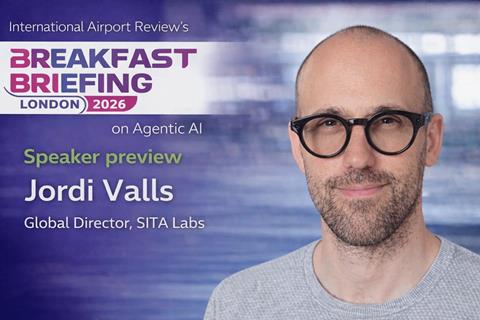
Jordi is speaking at International Airport Review’s breakfast briefing taking place on 18 March 2026 at Crowne Plaza, London Docklands by IHG, register now to attend and ask him your questions around launching agentic AI at your airport.
 Jordi Valls is an experienced entrepreneurial technology executive with over 15 years in the field, specialising in startups, scale-ups and corporate disruptive innovation with international proven experience. He is the founder of several initiatives like Startup Embassy and 1sleeve Inc. in Palo Alto, Silicon Valley. In 2018, he founded mentor-vr, a Virtual Reality solutions company focused on Employee Experience with clients like CaixaBank, ESADE, Wyser and Emergia, where Jordi holds the role of CEO.
Jordi's career includes significant roles at Decelera, Carnovo, The Knot Worldwide, Sunday and now at SITA. His achievements include successful product launches, managing cross-functional teams, and driving significant growth and innovation in challenging, fast-paced environments. His expertise lies in aligning product development with business goals, leading diverse teams, and leveraging technology to create impactful user experiences.
Currently leading SITA labs, a global team of business leaders, engineers and designers to create bold new products for SITA.