
Luis Cañón, Innovation & Customer Experience Director at Aena, outlines how the operator is leveraging the latest cutting-edge technologies within Madrid Airport’s operations to revolutionise the airport experience.

Adolfo Suárez Madrid-Barajas Airport (MAD), operated by Aena, has in recent years established itself as one of the most innovative and technologically advanced hubs in the world. With over 66 million passengers in 2024, four terminals and connections to more than 200 destinations, it not only serves as a key node for global connectivity but has also become an international benchmark in the application of emerging technologies that are transforming passenger experience, operational efficiency, airport sustainability and new revenue generation.
What truly sets MAD apart is not merely its size or traffic volume, but its ability to anticipate the future and swiftly adapt to the sector’s evolving demands. In recent years, the airport has deployed a range of technological solutions that have turned it into a real-time innovation laboratory.
Technology serving the passenger
In its commitment to enhancing customer experience and improving communication with travellers, one of the most notable initiatives has been the implementation of an AI-powered travel assistant, based on cutting-edge language models (LLMs). This assistant offers features such as flight information, subscription-based updates, interactive maps, layover assistance, travel documentation, baggage restrictions and weather forecasts. It supports multimodal inputs – text, voice and images – and is available in eight languages across multiple channels: physical airport screens, website, app, Facebook Messenger, WeChat and WhatsApp. Currently, nearly four million users utilise it, with a 99% automation rate in responses, significantly reducing the need for human intervention.

The AI-powered travel assistant supports multimodal inputs – text, voice and images – and is available in eight languages across multiple channels: physical airport screens, website, app, Facebook Messenger, WeChat and WhatsApp. Currently, nearly four million users utilise it, with a 99% automation rate in responses, significantly reducing the need for human intervention. c: Aena[/caption]
Additionally, to create a seamless and efficient shopping experience, a new autonomous shop has recently been launched in the airport’s T4 Satellite. It allows travellers to purchase items frictionlessly using a system that links their credit card to their silhouette, eliminating the need for scanning or manual payment and greatly streamlining the shopping process.

Aena has implemented an AI-powered travel assistant, based on cutting-edge language models (LLMs). The assistant offers features such as flight information, subscription-based updates, interactive maps, layover assistance, travel documentation, baggage restrictions and weather forecasts. c: Aena[/caption]
Listening to the customer as a driver of change
Aena has launched an ambitious cross-cutting Voice of the Customer (VoC) programme, using commercial tools such as Qualtrics and Sprinklr. This programme enables the systematic collection, analysis and action on passenger feedback, drawing insights from surveys, social media and customer service interactions. Thanks to this approach, the company is transforming into a data-driven organisation focused on designing services and products based on customer insights, empowering staff to respond proactively and continuously improve service quality.
Cultural personalisation: The “Hi China” case
One of the most innovative market segmentation initiatives is the “Hi China” project, designed to enhance the experience of Chinese passengers travelling to Spain. This programme promotes the airport’s commercial offering and the Madrid destination through digital channels native to the Chinese market, resulting in a significant increase in sales targeted at this segment.

The “Hi China” project promotes the airport’s commercial offering and the Madrid destination through digital channels native to the Chinese market, resulting in a significant increase in sales targeted at this segment. c: Aena[/caption]
Smart mobility and accessibility
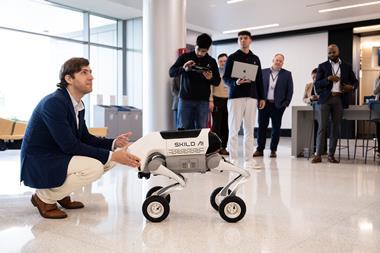
Innovation has also materialised in solutions that improve accessibility and mobility within the airport. Autonomous wheelchairs are being trialled, allowing passengers to move independently through the terminal using an interactive tablet to select stopping points. Additionally, the Aena Maps app provides precise and accessible indoor navigation, aiding orientation and guidance within the terminal.

Autonomous wheelchairs are being trialled, allowing passengers to move independently through the terminal using an interactive tablet to select stopping points. c: Aena[/caption]
Cutting-edge operational efficiency
Adolfo Suárez Madrid-Barajas has positioned itself as a global leader in operational efficiency. It recently achieved a milestone by becoming the first major airport in the world to remotely operate all 129 boarding bridges, managed from three control centres. This automation marks a qualitative leap in cost savings and operational flexibility.
AI-powered video analytics are being deployed at over 470 process points, enabling real-time monitoring of aircraft movements, passenger flows and airport access.
Artificial intelligence (AI) has also been integrated into airfield management. Vehicles equipped with sensors and cameras detect foreign objects (FODs) on runways with over 90% accuracy, while specialised drones carry out inspection and maintenance tasks both inside and outside the facilities. Furthermore, AI-powered video analytics are being deployed at over 470 process points, enabling real-time monitoring of aircraft movements, passenger flows and airport access.
Technologies such as LiDAR and mobile signal sensors, currently under development by Aena, allow for highly accurate measurement of waiting times and user behaviour, optimising resource allocation. In parallel, a collaborative baggage management platform is being developed, integrating data from the airport, airlines, handling agents and electronic tags to enable real-time baggage tracking, improving traceability and reducing incidents. This is a clear example of how the airport collaborates with various stakeholders involved in processes to innovate jointly.
Immersive staff training
Staff training has also been a focus of innovation. A virtual training platform is being developed, allowing firefighters, marshallers and maintenance technicians to train using advanced simulations, providing continuous, immersive training tailored to real operational needs.
All these advancements have not only improved efficiency and user experience but have also positioned Madrid-Barajas Airport as a global reference in the practical application of emerging technologies in the airport environment. Its pragmatic approach, based on collaboration with start-ups, intensive data use and intelligent automation, demonstrates that innovation is not an end in itself but a powerful tool to transform the way we travel.
MAD is a clear example of how a well-designed and executed corporate innovation strategy for an airport network can be implemented in a real environment and generate tangible impact across multiple areas – from cost savings and new revenue generation to fostering an organisational culture centred on innovation and continuous improvement.
In a constantly evolving sector, Adolfo Suárez Madrid-Barajas has shown that leadership is not just about moving millions of passengers, but about doing so in a smarter, smoother and more connected way. Its technological vision sets the course for the airports of the future.
 c: Aena[/caption]
 Luis Cañón brings over 15 years of comprehensive experience in air navigation, facilities, engineering, maintenance, airport security and IT, most recently as the Deputy Director of Madrid-Barajas Airport. His leadership was instrumental in adapting the airport’s operations during and post-pandemic. In his role as the Innovation & Customer Experience Director at Aena, he is responsible for the innovation and digital strategy roadmap, integrating the latest technologies into the company, overseeing the open Innovation Program, Aena Ventures, and represents Aena in European Groups focused on Innovative Air Mobility. Luis’s expertise extends to a wide range of technologies including 5G, AI, video analytics, AR/VR, IoT, big data, bots, autonomous vehicles, biometrics, eVTOL and vertiports. Luis’s academic credentials include a Master’s Degree in Industrial Engineering, a Master’s Degree in Aerospace Engineering, a Bachelor’s Degree in Law, and a PDD from IESE.