



The deadline for the full implementation of the Europe’s Entry/Exit System (EES) is April 10 2026, but the European Commission has said that Member States are able to “partially suspend” EES during the summer travel peaks.

The European Commission has said that is “foresees already certain flexibilities for Member States” for the period after the completion of the roll-out of the EU new Entry/Exit System (EES) in April this year.
Markus Lammert, European Commission Spokesperson for Internal Affairs, said: ”This means that by 10 April 2026 all Member States will need to fully deploy the EES across all their Border Crossing Points and register all third country nationals crossing the borders.
“After the completion of the roll-out, Member States will still be able to partially suspend EES operations where necessary during a period of an additional 90 days with a possible 60-day extension to cover the summer peak. This is foreseen in the legislation and will give MS the necessary tools to manage potential extended queues.”
This comes after concerns from airports that the EES will cause long queues for passengers during the summer travel peaks.
What is the EES?
The EU Entry/Exit System (EES) is implemented in EU countries (except for Cyprus and Ireland), as well as Iceland, Liechtenstein, Norway and Switzerland.
The EU digital border system was launched in October 2025 and requires third country nationals entering the Schengen area to register their personal records digitally. The system which replaces manual stamping of passports and has been gradually rolling out across 29 countries’ airports and ports, but the biometric technology has been experiencing teething problems and technical outages which have caused significant delays for passengers travelling by air, ferry and Eurotunnel.
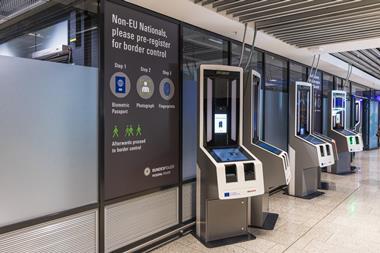
Under the EES those travelling from non-EU and non-Schengen countries including the UK must register their fingerprints and facial images the first time they cross the border. This data is recorded in an EU-wide database which tracks when a visitor enters and exits the Schengen area and can track people staying beyond the 90/180 day rule.
In December 2025, ACI Europe had called on the European Commission to urgently address the “mounting operational issues” brought by the implementation of the system which saw processing times at airports increasing by up to 70%, with waiting times of up to seven hours at peak traffic periods - significantly impacting the passenger experience.
Olivier Jankovec, Director General of ACI EUROPE warned: “Significant discomfort is already being inflicted upon travellers, and airport operations impacted with the current threshold for registering third country nationals set at only 10%. Unless all the operational issues we are raising today are fully resolved within the coming weeks, increasing this registration threshold to 35% as of 9 January — as required by the EES implementation calendar — will inevitably result in much more severe congestion and systemic disruption for airports and airlines. This will possibly involve serious safety hazards.”
He added: “We fully understand and support the importance of the EES and remain fully committed to its implementation. But the EES cannot be about mayhem for travellers and chaos at our airports. If the current operational issues cannot be addressed and the system stabilised by early January, we will need swift action from the European Commission and Schengen Member States to allow additional flexibility in its roll‑out.”
In December, Lisbon Airport was forced to suspend EEs after what they said were “serious deficiencies” at their border control which resulted in queues reaching seven hours.