

Airports must balance biometric innovation with trust, transparency and interoperability to accelerate passenger flow, enhance security and unlock commercial value.
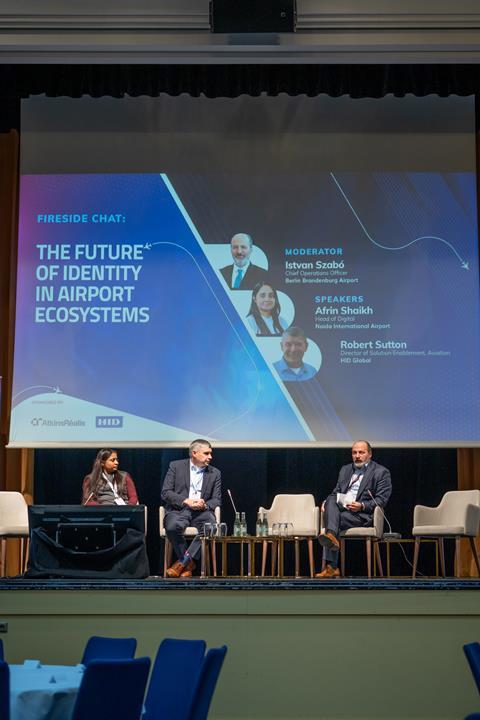
Biometrics promise what every airport leader wants: faster processing, stronger security, paperless journeys and improved commercial performance. Yet the path to achieving that vision is far from straightforward. Passenger trust remains fragile, regulatory frameworks are tightening and integration with legacy systems is complex.
During a frank discussion at the International Airport Summit, Istvan Szabó, Chief Operations Officer of Berlin Brandenburg Airport, joined Afrin Shaikh, Head Digital at Noida International Airport, and Robert Sutton, Director of Solution Enablement, Aviation at HID Global, to examine what it really takes to embed biometrics at scale.
From innovation to operational reality
At Berlin Brandenburg, biometrics are no longer theoretical. Szabó explained that the airport has been running its Smart Depart biometric solution for several years, achieving comparatively strong adoption rates within Germany. With the EU’s Entry Exit System being rolled out, the airport is preparing to extend biometric processing further.
“For us, it is about providing a more seamless experience,” he said, noting that the aim is to remove friction points, such as repeatedly presenting boarding cards at security and boarding.
The obstacles today are that there are biometric programmes, successful ones, but once a passenger leaves India, they mean nothing.”
Yet even at an established European hub, integration remains the primary challenge. Airports are complex ecosystems. Any biometric solution must connect with airline departure control systems, security screening, border control and operational databases without disrupting throughput.
Sutton emphasised that airports must first define their objective. “What is it that you are looking to solve with biometrics?” he asked. “Is it efficiency? Is it reducing queues? Is it increasing security? Or is it all those things?”
Without that clarity, airports risk deploying technology without delivering value.
Designing for diversity
If Berlin’s challenge is integration, Noida’s is adoption across a diverse demographic base. As a greenfield airport opening with an initial capacity of six to seven million passengers and scaling to 70 million, Noida has the advantage of designing biometrics into its architecture from day one.
But Shaikh was quick to underline the human dimension. “Biometrics is not something which is easily understood by a lot of passengers,” she said. India’s traveller profile spans digital natives and those less familiar with emerging technologies. “It has to work not only for Gen Z or millennials, but passengers of any age.”
To address this, Noida has run large scale simulation trials, inviting around 1,000 friends and family members to experience the airport. Adoption during those trials reached roughly 60%. However, nationwide usage of India’s DigiYatra system remains closer to 10%.
“The adoption rate is only 10%,” Shaikh admitted. “The diverse knowledge of DigiYatra is still yet to be there.”
Her conclusion was unequivocal. Education must accompany infrastructure. “If we do not make a conscious effort to collaborate with our stakeholders on the ground, it will not be successful.”
Trust is the tipping point
Across regions, adoption patterns reflect levels of trust and regulatory clarity. Sutton pointed to the United States, where government managed programmes such as Global Entry and TSA PreCheck have achieved strong uptake. “When passengers see the advantage, and when there is trust in how the data is managed, adoption increases,” he explained.
In parts of the Middle East, uptake has also been strong, in part because privacy concerns are less publicly contested. In Europe, by contrast, greater regulatory scrutiny and data protection awareness can slow deployment.
I really want to go paperless at the airport so that there is no boarding pass.”
Szabó raised a provocative observation. Billions of people use facial recognition daily to unlock smartphones or access financial apps. Yet when biometrics are introduced at airports, hesitation often follows.
Sutton acknowledged the paradox. “Every five minutes people are pulling out their phone and using facial to unlock it. You don’t even think about it,” he said.
The difference, the panel agreed, lies in transparency and perceived control. Passengers want clear answers to simple questions: where is my data stored, how long is it retained and who has access?
“It all comes back to education and transparency,” Sutton affirmed. “What am I doing with the data? How am I processing it?”
Efficiency as commercial strategy
While trust and compliance dominated much of the conversation, Shaikh reframed biometrics through a commercial lens.
“Passengers should not be waiting anywhere across the airport,” she said. “Rather they should be enjoying the commercial spaces.”
For her, time saved in queues is not merely an operational metric. It is potential retail spend. “Passengers are not going to buy anything while standing in queues,” she observed.
This perspective is critical for terminal development managers and commercial directors. Biometric throughput directly influences dwell time and spend per passenger. If technology reduces friction at check in and security, passengers can redirect those minutes towards retail and food and beverage.
Szabó echoed this dual objective. Airports must balance operational benefits with passenger comfort. Faster is valuable, but so is smoother.

Avoiding a one size fits all approach
Sutton cautioned against blanket solutions. “You’ve been to one airport, you’ve been to allairports,” he said, referencing a familiar industry phrase. While facial recognition has become the dominant biometric modality, each airport’s demographic mix, regulatory context and traffic profile requires tailored implementation.
He also highlighted improvements in algorithm performance. Earlier concerns around demographic bias have been reduced significantly. “We are able to look at different demographics, different skin tones and make sure we are delivering the same level of experience,” he stated.
Yet even with technical progress, stakeholder alignment remains essential. Airlines, security providers and border authorities must all move in step.
Interoperability remains the missing link
Perhaps the most strategic barrier discussed was interoperability. DigiYatra works within India, but it does not extend automatically beyond its borders. Biometric systems today remain largely national.
“The obstacles today are that there are biometric programmes, successful ones, but once a passenger leaves India, they mean nothing,” Sutton shared.
The long-term solution lies in digital travel credentials, supported by international bodies and governments. In this vision, passengers enrol once and use their biometric identity across multiple jurisdictions.
Shaikh summarised her aspiration simply. “I really want to go paperless at the airport so that there is no boarding pass. It is just your face as your ID.”
Sutton extended that vision further. “You move through the airport, your face is your token at all touchpoints, boarding, lounge access, payment at duty free.”
Security beyond passengers
An audience question broadened the discussion to staff security and perimeter control. Szabó noted that many airports already use biometric elements within staff access systems. Over the next decade, facial recognition integrated with airport ID could reduce reliance on physical badges.
“I think the time will come,” he said, suggesting that within 10 years, staff identification may rely more heavily on biometric verification.
However, he also urged caution. Airports remain a critical national infrastructure. Regulatory frameworks must evolve in tandem with technology to manage risk.
Shaikh agreed, pointing to tightening AI governance in India. New regulatory branches are emerging to oversee AI applications and mitigate vulnerabilities. Innovation and regulation are advancing simultaneously.
Looking towards 2035
By the end of the discussion, a shared trajectory had emerged. By 2035, paperless travel within airports may become standard. Boarding cards and even physical passports could be secondary to biometric verification.
But the route there will require sustained focus on education, transparency and collaboration.
Biometrics are not simply an IT project. They are a strategic transformation touching operations, commercial revenue, border control and passenger psychology.
As Sutton concluded, the most successful deployments are voluntary. “We are not forcing somebody in. It is there for them to participate.”
In an industry defined by trust and precision, airports that align technology with clear passenger value will lead the next phase of seamless travel. Those who neglect the human dimension may find that even the most advanced systems struggle to gain acceptance.
The challenge for terminal development managers is therefore not whether biometrics will shape the future. It is how to build the confidence that allows that future to take off.







No comments yet