
Michelle Sandbrink, Corporate Strategy and Sustainability Management, Fraport outlines how Frankfurt Airport is accelerating its long term renewable energy strategy through offshore wind, innovative vertical PV and large scale electrification to deliver resilient, low carbon airport operations.
Airports require continuous, substantial energy for all operations, from terminals, runway systems, data centres, baggage facilities, to security checkpoints. As the electrification of ground equipment, vehicle fleets and building systems increases demand, the key challenge is achieving a robust, economically viable renewable transition.
Our energy strategy has to deliver three things at once: decarbonisation, reliability and planning certainty.
Unlike other facilities, airports can't scale back when energy gets scarce or expensive. Security systems, lighting, climate control, digital infrastructure, everything must function without interruption. Our energy strategy has to deliver three things at once: decarbonisation, reliability and planning certainty. Buying renewable electricity on short-term contracts might look good in reports, but it doesn't provide long-term security and rarely helps expand renewable capacity.
Fraport’s long term renewable energy strategy
Fraport´s long-term energy strategy is translating into concrete results through binding power purchase agreements and on-site renewable energy generation. That's why Fraport committed to long-term power purchase agreements (PPAs) with wind energy providers. Since 2021, onshore wind power supplied by various providers has been an integral part of Frankfurt Airport’s electricity mix. From mid-2026 onwards, Fraport will significantly scale up its renewable energy sourcing through an offshore wind PPA linked to the He Dreiht wind farm in the North Sea, developed by EnBW. The long-term contract guarantees Fraport 85 megawatts (MW) of renewable power, corresponding to about 372 GWh of annual electricity generation and roughly 123,000 tons of avoided CO2e emissions. Beyond emission reduction, long-term PPAs provide stable pricing, strengthen security of supply and directly support the expansion of new renewable generation capacity.
On-site solar innovation
Buying renewable electricity on short-term contracts might look good in reports, but it doesn't provide long-term security and rarely helps expand renewable capacity.
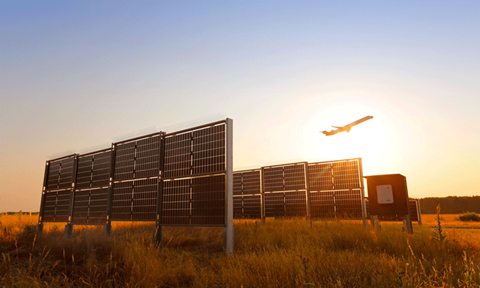
In addition to external renewable sourcing, on-site generation plays a key role in Fraport’s energy strategy. With the photovoltaic system alongside runway 18 West, Fraport has implemented an innovative solar solution specifically designed to meet the operational and safety requirements of an international airport. The project applies a vertical photovoltaic design that enables the productive use of land which would otherwise not be suitable for conventional solar installations. In addition, the vertical photovoltaic design supports biodiversity by allowing vegetation growth and habitat continuity beneath and between the panel rows, which was a key consideration in the project´s layout. Covering an area of 30,6 hectares, the installation comprises 34 vertical PV rows with a total installed capacity of 17,4 MWp. Once fully operational, it has the potential to avoid 5,700 tons of CO2e emissions per year. The vertical configuration ensures compliance with stringent aviation safety and glare protection requirements while improving land-use efficiency and supporting reliable integration into the local power grid.

Vertical PV next to runway 18 west at Frankfurt Airport.
c: Fraport AG[/caption]
Enabling airport electrification
Renewable electricity is not the finish line; it is what makes everything else possible.
At Frankfurt Airport, large-scale renewable source is combined with on-site generation to ensure that electrification leads to genuine emission cuts, rather than simply relocating emissions elsewhere. Clean energy enables the electrification of ground handling equipment, the expansion of charging infrastructure, and emission-free cooling systems. About a quarter of Fraport’s vehicle fleet is already electric, supported by a growing charging network across the airport. To further advance sustainable mobility, Fraport is exploring the potential of bidirectional charging through an ongoing research project, enabling vehicles to both draw from and feed energy back into the grid. Additionally, clean electricity drives the continued digitalisation of operations at Frankfurt Airport, contributing to a more efficient and sustainable airport environment.
Overcoming operational challenges
Implementing energy transition in a complex operational environment means dealing with regulatory, technical and organisational challenges. Permitting procedures are often lengthy, grid capacities are limited, and land use requirements highly competitive. Our experience shows that three things are essential: faster permitting for renewable projects at critical infrastructure sites, regulatory recognition of long-term power purchase agreements, and system-level planning. Climate protection and operational resilience aren't contradictory goals, diversified renewable sourcing strengthens both energy security and environmental performance.
Sustainability as a strategic priority
At Fraport, sustainability is not a standalone initiative but a core element of our corporate strategy. Climate protection, operational resilience and long-term economic stability are addressed together, with energy supply as a central lever. Airports operate 24/7 and rely on secure, uninterrupted electricity for all critical systems. Fraport’s commitment to the net zero goal by 2045 therefore requires large-scale decarbonisation of Scope 1 and 2 emissions without compromising safety, reliability or financial viability. Sustainability is integrated into investment decisions, operational processes and infrastructure development to ensure that ambitious climate action and operational reliability go hand in hand.

c: Fraport AG[/caption]
Knowledge transfer across airports
The experience gained at Frankfurt Airport, together with insights from Fraport’s international airport portfolio, offers valuable lessons for the wider airport sector. Through systematic know-how transfer across the group, practical experience from different regulatory, operational and climatic contexts is consolidated and applied at scale. Meaningful decarbonisation requires scale rather than symbolic pilot projects. Renewable energy sourcing should be embedded in operational and infrastructure planning from the outset. Aviation-specific constraints can act as drivers of innovation when addressed in a structured way. And airports, with their long investment horizons and high energy demand, are well positioned to serve as anchors for regional energy transitions.
From ambition to action
At Frankfurt Airport, accelerating the energy transition means implementing solutions that perform reliably under real-world constraints. Long-term wind power purchase agreements and the PV 18 West installation are permanent elements of Fraport's pathway towards our goal of net zero, supporting both climate objectives and operational stability. These experiences illustrate what accelerating the energy transition truly means in the context of operating critical airport infrastructure. The energy transition in aviation won't be achieved through ambition statements alone, but through contracts signed, infrastructure built and renewable electricity flowing reliably, day after day.
Michelle recently took part in International Airport Review’s live webinar on ‘Accelerating the energy revolution in airports’. You can watch the webinar on-demand at your leisure by registering your details on our website.
Michelle Sandbrink works in Corporate Strategy and Sustainability at Fraport AG, where she focuses on climate protection initiatives and the strategic development of the company's decarbonisation pathway. With a background in geology and experience researching climate change impacts, she now applies scientific rigor to the practical challenge of transforming airport operations toward climate neutrality under real-world operational constraints.