


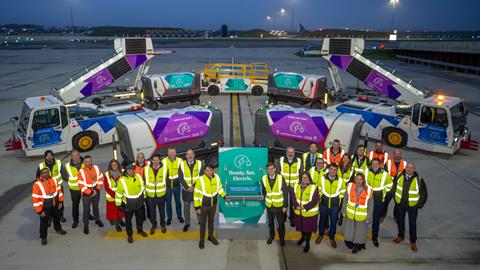
London Luton Airport has replaced diesel ground equipment with a pooled electric fleet open to all handlers, while construction continues on a new on-site solar farm.
Aviation Minister Keir Mather MP has activated a fully pooled fleet of electric ground service equipment (eGSE) at London Luton Airport (LTN), replacing diesel-operated equipment with zero-emission alternatives.
The centralised fleet is available to all airline ground handlers at Luton Airport and will be used for ramp services including baggage transport and loading, aircraft towing and the transportation of passenger boarding steps. The airport said the transition will reduce ground noise for passengers and staff, improve aircraft turnaround times and cut operating costs and carbon emissions.
Pooled model avoids fixed charging infrastructure
Rather than following a traditional fixed infrastructure approach, the scheme uses a flexible solution that avoids disruptive groundworks and oversized power infrastructure, enabling GSE electrification at pace. The equipment was sourced in partnership with eGSE solutions provider TCR, and the project marks a key milestone in Luton’s long-term ambition to decarbonise its ground operations.
Alberto Martin, Chief Executive Officer at London Luton Airport, said: “London Luton Airport’s transition to a fully pooled eGSE solution marks a significant stride forward in the decarbonisation of our ground operations. It is an investment that pushes the boundaries of convention in the aviation sector, combining GSE pooling, smart mobile charging and Infrastructure as a Service (IaaS) innovation in ways that will benefit our passengers, ground handler staff and the local environment.”
Kristof Philips, CEO of TCR Airport Solutions, added: “The future of airport operations will depend on how effectively infrastructure, equipment, energy, software, and operational processes work together. Through this project, London Luton Airport is introducing a new model that brings these elements together in a practical way.”
The Minister also toured a new solar farm under construction, which is set to generate more than a third of the airport’s current electricity demand.
Once complete, the 26-acre site south of the runway will feature more than 14,000 solar panels and generate up to 11.2 GWh of electricity, equivalent to the energy needed to power 4,148 homes a year. The facility is due to begin generating energy in March 2027, with a predicted carbon saving of 1,982 tonnes CO2e in its first year.
The array is being installed across five development areas, connecting to six new substations. The project is being delivered by the airport operator with the support of Luton Rising, the Luton Council-owned company that owns the airport, while Zestec, owned by funds managed by Octopus Energy Generation, will provide active long-term asset management.
Mather said: “London Luton Airport is showing that cleaner, quieter, more efficient airport operations are within reach. Going electric on the ground, backed by a new solar farm, is a real step towards net zero, and it benefits passengers, staff and the local area.”
Nick Platts, Managing Director of Luton Rising, said the projects “demonstrate how innovation can help create a cleaner, more efficient airport while supporting the growth that brings jobs, investment and opportunities to Luton and the wider region.” He added that Luton Rising’s legally binding Green Controlled Growth framework sets strict limits on noise, operational emissions and air quality as the airport grows.








No comments yet