

International Airport Review explores how data, AI and people can unlock airside capacity without pouring new concrete.
Airside infrastructure is expensive, slow to deliver and increasingly difficult to approve. That reality framed a wide-ranging discussion at the International Airport Summit, where airport operators and technology leaders examined how capacity can be released from existing assets, rather than built from scratch.
Opening the session, moderator Chris Miles, Chief Operating Officer of the Calgary Airport Authority, set out the scale of the challenge. Drawing on Calgary’s recent runway works, he reminded the audience that “airside infrastructure is exceptionally expensive,” citing costs of “€18,500 per panel” before permissions are even considered. For many airports, he argued, the question is no longer what to build next, but “how do you generate enough efficiency in your current asset to offset future growth?”
That pressure is compounded by trade-offs. New infrastructure may deliver peak capacity, but often at a price. Miles pointed to European examples where airports gain a new runway only to face overnight closures, limiting freight and off-peak operations. Against that backdrop, the panel focused on extracting more value from what already exists, using technology, data and operational change.
Strategy before dashboards
A recurring theme was that technology alone does not unlock capacity. Marco Rueckert, Chief Technology Officer of Searidge Technologies, warned that many airports fall into the trap of buying tools without a clear operational objective. “Traditionally there have been Request for Proposals (FRP) with 2,000 requirements and it ends up exactly that. We buy another tool with another dashboard,” he said, often creating “conflicting points of data to something that you already have.”
Successful programmes, he argued, start with operations, not software. Describing work at Hong Kong International Airport, Rueckert explained how the focus was first placed on capacity constraints and operational goals, before translating those into data models. “We started with the operation first and said, what are your capacity challenges? What do you want to do? How do you want to unlock capacity?”
Re-use of infrastructure is another critical lever. Rueckert noted situations where “you end up with three cameras on the same mast” because different departments procure in silos. His message was clear. “If you make the investment once, how do you sweat this asset for different purposes?”
That principle extends to data sharing between airports and air traffic control. “If I have a last-minute stand allocation change and my air traffic controller doesn’t know about it,” Rueckert expressed, “you can have the best stand allocation system in the world, the traffic controller is still going to make the decision they’re going to make.”
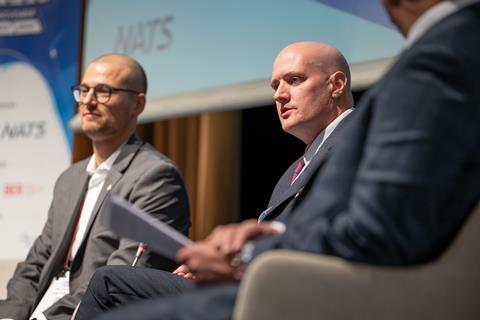
From reactive to predictive
Graeme MacLeod, Airfield Product Director at Manchester Airports Group, challenged the idea that being data-driven is enough. “Every airport claims to be data driven,” he said. The real distinction, in his view, is whether AI is used to think ahead rather than simply react faster.
At East Midlands Airport, Manchester Airports Group has deployed AI-driven stand planning. The impact is not just speed, but flexibility. “This allows us to reduce the planning window right down to just before the aircraft arrives,” MacLeod explained, replacing rigid 24-hour plans that quickly become obsolete.
That has implications beyond punctuality. More efficient stand planning can reduce taxi times, cut CO2 emissions and allow parts of the airfield to be closed when not needed. While it is “still very early days,” MacLeod sees the potential for better use of stand capacity and, over time, improved commercial performance.
Miles was keen to push the discussion beyond efficiency into revenue. Airside, he argued, should not be seen purely as a cost centre. “It is really a revenue generator,” he said, particularly when stand allocation decisions influence walking distances, passenger experience and dwell time in retail areas.

Bringing people along
Despite the promise of automation, the panel repeatedly returned to the human dimension. “Aviation is a business about people, for people and by people,” Miles emphasised. For AI to work on the apron, frontline operators must trust it.
Rueckert illustrated the point with an example from Doha International Airport, where Searidge implemented an automated traffic light system at a taxiway crossing. Although the system was technically capable of autonomous operation, the human operator was unconvinced. “I have no trust in the system whatsoever,” was the response.
The solution was to step back from full autonomy and introduce a semi-automatic mode, where the system made suggestions and the operator retained control. “We ran like this for almost a year,” Rueckert said, building trust gradually. Accountability, he noted, still sits with the human. “We’re not at a point where we can assign accountability and liability to autonomous systems.”
MacLeod agreed that, for now, the system advises and the human decides. “The system can give you really strong and predictable recommendations,” he said, but “ultimately in the air traffic environment, the human remains accountable for the action.” Over time, however, he expects the question to evolve from why a recommendation was followed to “why did you deviate from the recommendation?”
That shift raises new challenges, including complacency. Asked how to prevent operators from becoming over-reliant on AI, MacLeod described a progression from augmentation, to informed decision-making, and eventually to directed action. Rueckert added that monitoring reaction times and building independent safety nets can help maintain engagement without being punitive.
The next frontier
Looking ahead, Rueckert was cautious about promising breakthroughs. “I’m sorry I don’t have anything earth shattering for you,” he conversed. For him, the real enablers are cloud and AI, not as buzzwords but as accelerators. Cloud infrastructure can dramatically shorten deployment times. “If I can just flick a button in the cloud and I have something up in 30 minutes, that’s a whole game changer,” he articulated.
AI’s next step is predictability. Rather than showing where assets were seconds ago, Rueckert envisages systems that show where aircraft and vehicles will be seconds ahead. “If I know to a certain level of accuracy where things are going to be five seconds from now,” he observed, “you can then do that in a sort of a full surface optimisation.”
Miles connected this vision to digital twins and integrated operations centres, where real-time inputs support decisions on pushbacks, snow clearance and connection management. For hub airports in particular, the ability to balance minimum connection times with commercial exposure could reshape how airside capacity supports revenue.
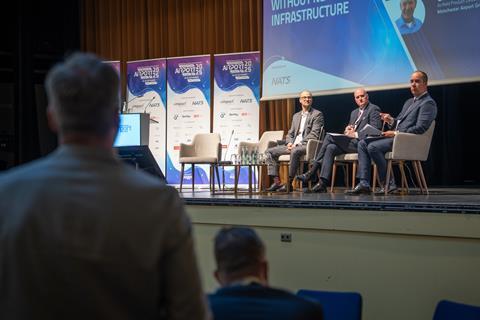
Aligning the ecosystem
None of this is possible without alignment across a fragmented ecosystem. MacLeod highlighted the persistent challenge of multiple stakeholders, from airlines and handlers to regulators, all operating across different airports and standards. “One of the things that the industry is struggling with,” he noted, is the lack of “a common format and a common ability for interested parties and suppliers to talk to that airport and exchange data.”
Despite years of collaboration, initiatives such as A-CDM still face barriers from differing architectures and messaging formats. Manchester Airports Group is responding by re-architecting its systems around an integration layer and common naming standards, but MacLeod was clear that industry-wide collaboration is essential.
As the session closed, Miles returned to the original premise. With airside infrastructure costs rising and permissions harder to secure, unlocking hidden capacity is essential. It demands clear strategy, shared data, trusted automation and, above all, end-users who are brought on the journey.
If these challenges resonate with your airport, the conversation is far from over. Register now for the International Airport Summit 2026, where industry leaders will return to the challenge of squeezing extra capacity out of existing assets.





No comments yet