


This article explores how airports in Latin America are accelerating the energy revolution, highlighting practical strategies and real-world experiences from El Dorado International Airport in Colombia, the Galápagos Ecological Airport (ECOGAL), Lima Airport and Brazil’s Salvador Bahia. Together, these cases illustrate how airports of different scales and contexts are turning climate commitments into concrete, measurable action.

From decarbonisation commitments to resilient, low-carbon airport operations in Latin America
As the aviation sector accelerates its path toward decarbonisation, airports are increasingly recognised as strategic enablers of the global energy transition. Operating 24/7 and supporting energy-intensive processes, airport infrastructure faces growing pressure to reduce emissions while maintaining the highest standards of safety, efficiency and passenger experience.
As net zero commitments become industry benchmarks rather than aspirations, airports are evolving into complex energy systems where renewable generation, efficiency, electrification, resilience and governance converge. In this context, accelerating the energy revolution is no longer a future ambition, but a present-day operational challenge.
Airports are critical infrastructures for economic development and global connectivity. Their continuous operation, the integration of multiple stakeholders, and the concentration of energy-intensive activities result in a high and constant demand for energy. These characteristics position airports as key players in the transition toward more sustainable, resilient, and low-carbon energy systems.
Recognising this responsibility, the airport sector committed in 2021 to achieving net zero carbon emissions by 2050. This commitment has driven the integration of energy transition strategies within a broader climate change management framework, encompassing rigorous greenhouse gas (GHG) measurement, clear reduction targets, mitigation priorities, and the incorporation of climate risk and operational resilience into decision-making processes.
Within this context, energy management is no longer a standalone operational issue, but a strategic pillar that shapes infrastructure planning, operational efficiency, innovation, and long-term competitiveness.
Airports as catalysts of the energy transition
The global energy transition driven by the Paris Agreement, decarbonisation targets and carbon neutrality goals requires structural changes and operational optimisation across all sectors. Airports, as complex ecosystems integrating transport, services and logistics, face the challenge of reducing their carbon footprint without compromising safety, efficiency or passenger experience.
Accelerating the energy revolution in airports is not only a response to global climate commitments, but an opportunity to redefine how airport infrastructure is designed, managed and operated.
At the same time, this complexity turns airports into ideal environments for innovation. Digital solutions such as biometric systems, automated passenger processes, smart security management, and data-driven operational tools not only enhance service quality but also contribute directly to energy optimisation by streamlining processes and reducing unnecessary energy consumption.
Accelerating the energy revolution in airports is therefore not only a response to global climate commitments, but also an opportunity to redefine how airport infrastructure is designed, managed and operated.
Regional leadership and diverse pathways
Across Latin America, airports are advancing along different but complementary pathways toward energy transition, shaped by their scale, geographic context and operational requirements.
In Brazil, Salvador Bahia Airport (SSA), operated by VINCI Airports, reached Airport Carbon Accreditation (ACA)1 Level 5 on 13 November 2025, becoming the first airport in Brazil and across the entire American continent to achieve the programme’s highest level. Level 5 recognises net zero emissions for Scopes 1 and 2 (under the airport’s control) and the airport’s commitment to reach net zero Scope 3 by 2050 through collaboration with partners and stakeholders. The certification was supported by concrete measures including two on-site photovoltaic plants totalling 6 MWp, exclusive use of 100% renewable electricity for airport and tenant operations, replacement of gas-powered equipment with electric alternatives (including tenant activities such as restaurants), conversion of the airport vehicle fleet to electric or biofuel-powered vehicles, ongoing stakeholder dialogue to foster joint emissions-reduction action, and offsetting residual emissions through certified carbon sequestration projects, including support for a 3,879-hectare reforestation initiative in Corumbá (Brazil).
In Colombia, El Dorado International Airport – recognised by Skytrax2 for the seventh time as the Best Airport in South America – handled nearly 46 million passengers and over 800,000 tons of cargo in 2024, consolidating its position as the leading airport in Latin America and the Caribbean. This operational leadership has been accompanied by a strong commitment to efficiency and sustainability, with energy management as one of its core strategic priorities.

Galápagos Ecological Airport (ECOGAL)[/caption]
Operating under very different conditions, but with even higher environmental demands, the Galápagos Ecological Airport (ECOGAL) demonstrates how energy transition can be embedded from the earliest stages of airport conception. Located in one of the world’s most fragile ecosystems, ECOGAL integrates efficient design, intelligent energy management, and a verified climate roadmap aligned with international standards.
Similarly, in Peru, Lima Airport inaugurated its new terminal in 2025 under the premise that larger infrastructure must also be more energy efficient. From design to operation, sustainability criteria and emissions management standards have been incorporated to minimise the environmental impact of this major expansion.
Together, these cases illustrate that there is no single pathway to accelerating the energy revolution, yet common principles emerge across different contexts.
Renewable energy as a strategic pillar
One of the most significant milestones in the energy evolution of airports has been the integration of renewable energy sources. Airports are transitioning from passive energy consumers to active participants in low-carbon energy systems.
On-site renewable generation, particularly through photovoltaic solar systems installed on terminal rooftops, parking structures and non-operational areas, has proven to be one of the most viable solutions. These initiatives are complemented by renewable energy procurement mechanisms, clean energy certificates and power purchase agreements that allow emission reductions even where on-site generation is limited.
In this context, Airports Council International (ACI) created the Airport Carbon Accreditation (ACA) programme to assess and recognise airport efforts in emissions management and reduction. Today, more than 121 airports in Latin America and the Caribbean participate in the programme.
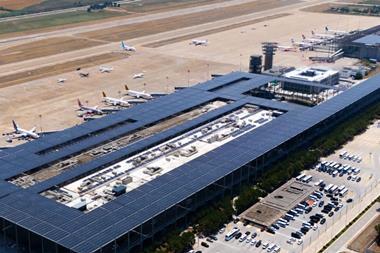
El Dorado International Airport began its decarbonisation pathway in 2018 by prioritising energy efficiency projects. In 2019, it installed 10,368 solar panels on the international terminal roof, supplying approximately 12% of the terminal’s electricity demand. In 2022, the airport complemented this initiative by acquiring renewable energy certificates to cover the remaining electricity consumption with renewable sources from the national grid.
At ECOGAL, the energy transition was embedded from the start of operations. Initially, the airport met 100% of its electricity demand through on-site solar photovoltaic systems – around 400 panels combined with wind energy generated by state-owned turbines on Baltra Island. After wind generation was discontinued, ECOGAL shifted its focus toward energy efficiency and intelligent demand management to sustain emissions reductions without compromising operations.
Meanwhile, Lima Airport relies on a certified renewable electricity supply contract under the I-REC3 scheme (hydropower), achieving up to a 100% reduction in the carbon footprint associated with electricity consumption. This strategy has been particularly impactful during the construction phase of the new terminal over the past three years.
Beyond emissions reduction, these strategies enhance energy resilience, reduce exposure to energy price volatility, and provide long-term operational cost stability.
Energy efficiency: reducing demand at the source
Accelerating the energy transition is not only about changing energy sources, but also about reducing overall demand. Energy efficiency remains one of the most cost-effective tools available to airports and is essential for understanding consumption patterns and identifying significant energy uses.

c: El Dorado International Airport[/caption]
At El Dorado Airport Upgrading HVAC4 systems, implementing efficient lighting, adopting bioclimatic building design, and deploying automation technologies can significantly reduce energy consumption. Digital energy management systems and real-time monitoring further support data-driven decision-making and continuous performance optimisation.
At ECOGAL, efficiency was integrated into the design and construction phase. The airport incorporates bioclimatic principles that minimise the need for artificial lighting and ventilation, and approximately 80% of materials from the former terminal were reused. This approach resulted in a structurally lower energy demand and enabled the deployment of intelligent control systems such as LUTRON5 for lighting automation and GEO SCADA6 for real-time electrical monitoring.
At Lima’s new Jorge Chávez International Airport, efficiency and sustainability criteria led to EDGE7 certification, confirming energy savings exceeding 20% compared to similar infrastructure. Additionally, the use of clean energy to operate 26 ground power units (GPUs) avoided 1,295 tCO₂e emissions during the first four months of operation.
While less visible than large renewable projects, efficiency measures are fundamental to ensuring a robust and lasting energy transition.
Electrification of ground operations
The electrification of airport ground operations has become another cornerstone of the energy transition. Ground support equipment, internal vehicle fleets and auxiliary systems traditionally powered by fossil fuels are increasingly being replaced with electric alternatives.
This shift delivers immediate local benefits, including improved air quality and reduced noise levels on aprons and operational areas. However, electrification requires integrated planning that considers charging infrastructure, grid capacity and intelligent demand management.
In response, El Dorado launched its Electric Mobility Master Plan in 2023. The initiative included electrifying the airport operator’s internal fleet and installing nine electric vehicle charging slots six in apron areas and three for public use in the main terminal parking facility. These chargers currently support approximately 33 vehicles operated by airlines and ground handling companies.
Additionally, public charging stations installed in one of the airport’s parking areas now serve around 250 vehicles per month at no cost to users. Further expansion of charging infrastructure is planned for parking areas and the cargo terminal to promote sustainable mobility across the airport community.
Energy resilience and storage
Complementing renewable generation, efficiency and electrification, energy storage is emerging as a critical enabler of resilience.
El Dorado is currently implementing one of Colombia’s largest Battery Energy Storage Systems (BESS), with an installed capacity of 7.5 MVAh. This system will ensure uninterrupted operation of critical passenger terminal services for up to 10 continuous hours in the event of power supply disruptions, strengthening operational resilience, energy autonomy and system reliability.
Governance, enabling role and climate leadership
Although aircraft account for the majority of aviation emissions, airports play a crucial enabling role in the sector’s energy transition. Infrastructure for sustainable aviation fuels (SAF), electric power supply at gates, and reduced reliance on auxiliary power units are tangible examples of how airports can facilitate cleaner aviation operations.
In this regard, Lima Airport, in partnership with Exolum, has reserved space for the future development of alternative energy solutions such as hydrogen and SAF.
The success of these transformations depends heavily on governance, financing models and strategic alignment. Integrating energy and climate management into corporate strategy, setting measurable and verifiable targets, and aligning with net zero objectives are key success factors.
Certifications and standards such as the Airport Carbon Accreditation, carbon neutrality schemes, LEED8, EDGE, and Blue Dot have become structural elements of airport climate governance. As a result of this comprehensive approach, El Dorado holds ACA Level 4 accreditation and carbon neutrality certification for Scope 1 and 2 emissions. Jorge Chávez International Airport holds ACA Level 3 accreditation and has committed to achieving net zero emissions for direct scopes by 2045 as part of the Fraport Group.
Access to sustainable finance, green bonds and public-private partnerships further enables high-impact projects, while collaboration with universities and technology providers fosters innovation and knowledge transfer.
Looking ahead
Despite significant progress, airports still face challenges such as high upfront investment costs, regulatory constraints, safety requirements, and the need to co-ordinate multiple stakeholders. Overcoming these barriers requires strategic vision, integrated planning, and a phased approach that combines short-, medium-, and long-term solutions.
Accelerating the energy revolution in airports is no longer optional it is essential for ensuring long-term sustainability and competitiveness. By embracing energy transition strategies, airports are evolving from transit hubs into platforms of innovation, resilience and climate leadership.
Special thanks to co-authors Jhon Ramos, Director of Electrical Maintenance; Jorge Rosillo, General Manager of Galápagos Ecological Airport; Melina Santos, Head of Sustainability and Environment Latin America & Caribbean Region VINCI Concessions and Julissa Salabarría, Sustainability Manager of Jorge Chavez Airport.
Discover how airports are leading the energy revolution in our upcoming webinar on 25 February – tune in live and ask San Francisco, Frankfurt and Venice Airports your burning questions, or watch on-demand at your leisure.
References
- A global programme by Airports Council International (ACI) that certifies airports’ efforts to manage and reduce carbon emissions through different levels of climate performance. https://www.airportcarbonaccreditation.org/
- An international air transport rating organization that evaluates and ranks airports and airlines based on service quality and passenger experience. https://www.worldairportawards.com/
- A standardised system that certifies electricity generated from renewable energy sources, enabling organisations to credibly track and report renewable energy consumption.
- Heating, Ventilation and Air Conditioning: A system designed to regulate indoor temperature, ventilation and air quality in buildings, ensuring thermal comfort and healthy indoor environments.
- A technology solution that enables automated and intelligent control of lighting systems to improve energy efficiency, comfort and operational performance in buildings.
- A supervisory control and data acquisition (SCADA) system used for real-time monitoring, control and analysis of electrical infrastructure and energy consumption.
- Excellence in Design for Greater Efficiencies: A green building certification developed by the International Finance Corporation (IFC) that promotes resource-efficient buildings through reduced energy, water and embodied energy in materials.
- Leadership in Energy and Environmental Design: A globally recognised green building certification system that evaluates the sustainability performance of buildings across energy efficiency, water use, materials and indoor environmental quality.
 Tania Chacin is a senior executive in sustainability, ESG, risk management, and quality, with over 25 years of experience leading corporate strategies, high-impact projects, and management systems in strategic sectors. Executive MBA with a Triple Bottom Line focus, and specialist in Natural Resources Management, Occupational Health, and Environmental Management.
Tania currently works at the El Dorado International Airport Concession (OPAIN) and is a Large Member of ACI World, where she leads and integrates corporate sustainability, environmental management, risk management, energy, climate, and management systems, aligned with international standards and focused on measurable results and ESG value creation.
Her background includes senior leadership roles in the floriculture sector, airport infrastructure, and consulting and certification organizations such as Bureau Veritas Colombia, Bogotá Chamber of Commerce, and OEGAC Ltda.
Tania specialises in strategic vision, complex project execution, decarbonisation, resilience, and creating economic, social, and environmental value, contributing to competitiveness and responsible decision-making.
 Natalia Rodriguez is an environmental engineer and project management specialist, with experience in sustainability, climate change, carbon footprint management, biodiversity, and circular economy. She currently works as Environmental Coordinator at El Dorado International Airport, where she has led strategic environmental projects, ensuring effective co-ordination with key stakeholders.
She has played a key role in international certification and recognition processes, including leading the Airport Carbon Accreditation (ACA) process for El Dorado International Airport, as well as the alignment of the airport with the principles of the Blue Dot Network (OECD). She is a professional passionate about biodiversity, continuous learning, writing, and collaborative work, with a strong interest in generating applied knowledge for sustainable development.