


Holly Miles sat down with Courtney Moore, Chief Revenue and Experience Officer of Los Angeles World Airports (LAWA), to discuss how LAX is reinventing the passenger experience ahead of the 2028 Olympic and Paralympic Games.
Say “L-A-X” to anyone outside the aviation industry and they will still know what you mean. Los Angeles International Airport is one of those airports that has transcended its physical entity and become rooted in popular culture. In a world where only those in the industry really know an airport’s IATA code, those three letters are instantly recognisable by all and are mentioned frequently in music, films and books.
Despite being one of the most recognisable airports in the world, the airport is also known for some of its long-standing challenges according to Courtney Moore, Chief Revenue and Experience Officer at Los Angeles World Airports (LAWA), the operator of LAX. Challenges such as wayfinding and congestion on the roads surrounding the major origin-and-destination airport have often made headlines.
In fact, LAX CEO John Ackerman told the LA Times that he plans to take LAX from “quantitatively one of the lowest-ranked airports in the world, to one of the best.”
“Our ambition is very straightforward: to make LAX the highest-performing large airport in North America by the time the Olympic and Paralympic Games arrive in 2028,” says Moore.
A billion dollar transformation programme
At the heart of this ambition is the $30 billion capital improvement programme, which includes:
- SkyLink: An electric train with six stations connecting passengers and staff to terminals, parking and pick-up/drop-off
- A consolidated rental car centre
- New roadway infrastructure including reconfiguration of 4.4 miles of roads and bridges around the Central Terminal Area to ease traffic
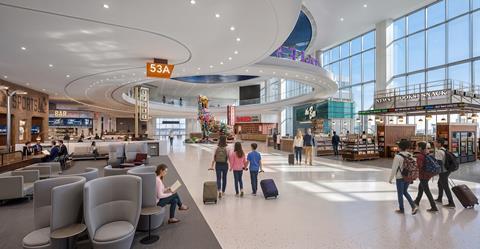
- Terminal 4 renovation
- Terminal 5 will be demolished and rebuilt
- Tom Bradley renovations including the Midfield Satellite Concourse South, a new 150,000-square-foot, eight-gate concourse built using off-site construction and relocation (OCR)
- Terminal 7 improvements
- Campus-wide wayfinding redesign.
The above changes to the physical envelope of the airport are only one part of the transformation. The other part is the fresh approach the airport is taking to its passengers and staff.
The first step, Moore says, is understanding its passengers at a much deeper level. The airport has conducted extensive customer journey mapping, identifying pain points throughout the airport experience and exploring what Los Angeles means to travellers.
“We firmly believe that good design must be human-centred. Rather than beginning with architecture, we start with emotion and storytelling. We ask what passengers are feeling throughout their journey and how we can create more positive emotional experiences.
“We then use a combination of traditional planning tools and advanced behavioural and physiological research techniques to test those assumptions.”
This includes passengers participating in studies involving eye-tracking technology and galvanic skin response monitoring to help Moore’s team understand how passengers react to different environments.
“For example, when redesigning wayfinding, we don’t simply ask whether passengers found the right sign. We analyse where they looked first, where they became confused and how long it took them to find the information they needed. This allows us to optimise signage placement, reduce stress and improve navigation far more effectively than traditional surveys alone.”
The airport also conducted a detailed segmentation study involving almost 1,500 passengers from Los Angeles, the wider United States and international markets. The research allowed it to map more than 210 airport touchpoints and identify distinct passenger personas, motivations and expectations.
At the moment, those personas are guiding the design process, rather than personalised service delivery. LAX is not yet operating a customer relationship management (CRM) environment in the way some other airports are beginning to explore.
Introducing storytelling through the terminals
As well as investing in the building structures themselves and the wayfinding, LAWA was interested in how it could improve the design and ambience of its terminals.
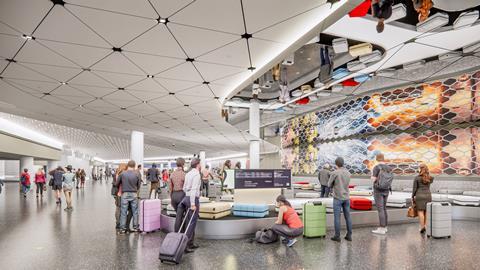
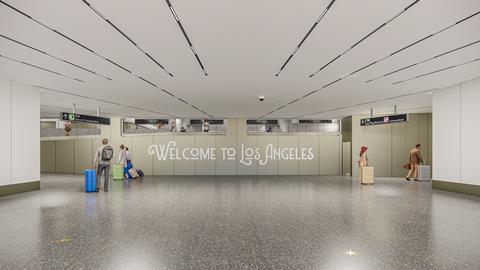
“What we’ve heard consistently is that travellers arrive expecting to experience Los Angeles the moment they enter the airport. LA is one of the world’s great cultural capitals, and passengers expect to see that reflected in the terminal environment. They expect creativity, culture, entertainment and a strong sense of place. Today, many passengers tell us they still see too many white walls and not enough of Los Angeles itself,” says Moore.
That insight has become one of the driving forces behind the LAX transformation programme.
“We’re reimagining the airport experience so that LAX feels unmistakably connected to the city it serves, and we’re moving quickly to bring that vision to life.”
What emerged from its passengers was a consistent theme: Los Angeles is about storytelling.
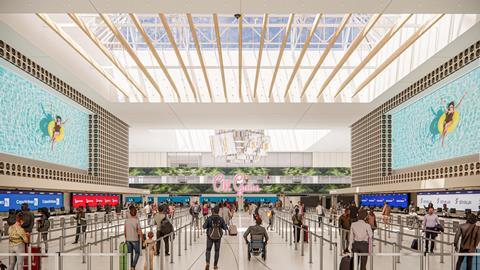
In response, LAWA has developed a campus-wide storytelling approach where each terminal has its own distinct identity inspired by different aspects of Los Angeles and California culture.
“Every terminal is being redesigned around a different chapter of the Los Angeles story.
“That extends to architecture, public spaces, concessions, branding, digital experiences and even employee interactions,” says Moore.
“At the same time, we recognised that customer experience cannot succeed without employee engagement, so the transformation extends far beyond physical infrastructure.”
The journey is designed to feel like a narrative as passengers move around the airport:
- Terminal 1: The vibrant souls and creativity of LA’s many neighbourhoods
- Terminals 2 and 3: California dreaming, celebrating optimism, music and natural beauty
- Tom Bradley International Terminal: ‘Sunny skies and Hollywood nights,’ blending beach culture with entertainment and film
- Terminal 4: Innovation, exploration and California’s engineering and design heritage
- Terminal 5: A day in the life of downtown Los Angeles, focused on urban energy and creativity
- Terminal 6: California’s early history and heritage
- Terminals 7 and 8: Living legends, celebrating the achievements and global influence of Los Angeles.
Together, the terminals create a cohesive but varied narrative across the entire campus.
Preparing for the FIFA World Cup and the Olympic Games
Having just hosted some of the matches during the 2026 FIFA World Cup, Los Angeles is preparing to welcome the 2028 Olympic and Paralympic Games, one of the biggest sporting and cultural events in the world. The eyes of the world will be upon LA and therefore the airport, which presents a hard deadline for its $30bn glow-up.
Running an Olympic airport operation is not easy, but LAX has hosted the Games twice before, so it has an existing playbook to draw from. Despite that, “it resembles planning a completely separate airport operation,” notes Moore.
The Games introduce unique requirements, particularly around baggage handling, oversized sporting equipment, accessibility and athlete movements.
“The Paralympic Games are especially important. They require us to evaluate accessibility standards at an entirely different level and ensure facilities can accommodate a much wider range of passenger needs. The planning effort extends from terminal design and equipment handling all the way through to restrooms, accessibility infrastructure and employee training.”
The LAX team has been analysing passenger forecasts, operational requirements and customer experience opportunities to ensure the airport is fully prepared.
Hospitality will play a central role in its preparation. In fact, one of the unique findings from the airport’s passenger segmentation work was that visitors expect to feel like Hollywood VIPs when they visit Los Angeles.
“To support that ambition, we sent 200 leaders through Ritz-Carlton hospitality training programmes to learn how world-class service principles can be applied in an airport environment. The objective is to create an ‘LA hospitality’ culture across the airport and ensure every passenger feels welcomed and valued.”
The 2028 Olympic Games are expected to draw 11,000 athletes from over 200 countries, and LAX predicts that it will handle over 100,000 extra passengers per day. For Moore and her team, the countdown is already under way.
By the time the Olympic flame arrives in Los Angeles, LAX hopes to have transformed not only how passengers move through the airport, but how they experience the city itself.








No comments yet