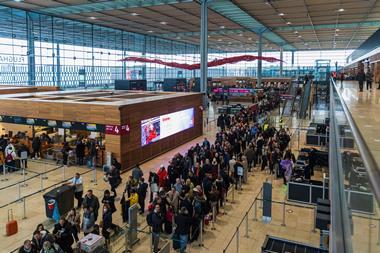



ACI Europe, in their air traffic report of 2023, found that passenger traffic had recovered by 48%. The growth is accredited to an influx of international travel, with a lesser impact made by domestic.

London,,Uk,-,April,15,,2018:,Air,Travelers,Check,Into

European airport trade body ACI EUROPE have released its air traffic report for February 2023. The results found that passenger traffic across European networks increased by 48% in February, compared to that of last year. The promising figures are accredited to a growth of international passenger traffic (at 58%), while domestic passenger traffic made a humble impact (at 22%).

When compared to pre-pandemic (February 2019) levels, passenger traffic in February 2023 stood at -12% - almost unchanged over the preceding month (-11% in January 2023). 40% of Europe’s airports had recovered or exceeded their pre-pandemic volumes.

Significant performance variations across national markets

With an increase of 53%, EU+ airports1 grew passenger traffic at the fastest pace in February compared to the same month last year. This reflects the fact that Omicron-related restrictions remained the tightest across this block. The highest increases came from airports in Cyprus, Malta (both at +92%) and Austria (+81%).

When compared to pre-pandemic (February 2019) levels, EU+ passenger traffic stood at -12% - but with significant divergences in performance:

  • 10 national markets achieved or exceeded a full recovery in February. The best performances came from airports in Portugal (+18.9%), Luxembourg (+10.9%), Cyprus (+9.7%), Malta (+5.3%) and Bulgaria (+4.9%)
  • Conversely, airports in Slovakia (-46.7%), Slovenia (-38.5%) and Germany (-33%), the Czech Republic (-29.9%) and Sweden (-28.3%) remained the farthest from achieving a full recovery. This reflected a mix of factors including the impact of the war in Ukraine, the lack of penetration or loss of Low Cost Carrier traffic and industrial action
  • Among the largest EU+ markets - and aside from the underperformance of airports in Germany - airports in Spain +2.2%) posted the best results followed by those in France (-7.3%), Italy (-10.6%) and the UK (-12.9%).

At airports in the rest of Europe2, passenger traffic grew by +23% in February compared to the same month last year.

The impact of the war weighed on performance – with the loss of all commercial air traffic for Ukrainian airports and passenger volumes increasing by just +1.5% at Russian airports. Meanwhile, other national markets posted impressive results, including airports in Israel (+111.2%), Armenia (+91.5%), Moldova (+89.7%) and Serbia (+88.2%).

When compared to pre-pandemic (February 2019) levels, passenger traffic in the rest of Europe became aligned with the EU+ market at -11%.

Airports in Uzbekistan (+116.6%), (+93.7%), Kosovo (+39.6%) and Serbia (+24.4%) far exceeded their pre-pandemic volumes. Those in the major market of Turkey (-6.8%) saw their performance affected by the devastating earthquakes that hit the country. Meanwhile, airports in Russia (+4.1%) remained above their pre-pandemic volumes as passenger traffic kept shifting to domestic and non-EU+ markets.

Recovery patterns shaping airport performance

Passenger traffic at the Majors (top five European airports in 20193) grew by +55% in February compared to the same month last year. Volumes remained -11.7% below pre-pandemic (February 2019) levels. The positive impact of the re-opening of the Chinese market was limited during the month – and still needs to materialise.

Amongst the current top five European airports4, Istanbul and Madrid remained the only ones having fully recovered their pre-pandemic (February 2019) levels:

  • London-Heathrow went back to being the busiest European airport in February. Passenger traffic increased by +81.6% over the same month last year, allowing the British hub to reduce the gap with its pre-pandemic volumes (-5.1%)
  • Istanbul came second, with passenger volumes growing by +41.6% over the same month last year and standing +4% above their pre-pandemic level. The Turkish hub was followed by Paris-CDG at +52.8% over February 2022 and -11.9% below its pre-pandemic volumes
  • Madrid kept the fourth position with its passenger traffic at +45.1% over February 2022 and +0.6% above pre-pandemic levels. Amsterdam-Schiphol closed the league at +42.1% over February 2022 and -21.9% below its pre-pandemic volumes.

The passenger traffic performance of other large5 and capital airports in February reflected a recovery still largely driven by intra-European and transatlantic routes, fuelled by leisure demand and characterised by significant (but selective) capacity expansion from Ultra-Low Cost Carriers.

  • Accordingly, Lisbon (+18.8%), Tel Aviv (+13.6%) Dublin (+2.4%), Athens (+2.2%) and Palma de Mallorca (+1.1%) all exceeded their pre-pandemic (February 2019) volumes
  • Meanwhile, Berlin (-44.1%), Munich (-29.3%), Helsinki (-28.1%), Prague (-28.7%), Frankfurt (-25%) and London-Gatwick (-22.3%) and Stockholm (-21.5%) remained well below.

These same recovery patterns and market dynamics were to the continued benefit of a number of large Ultra-Low Cost airport bases, bringing their February 2023 passenger traffic well above their pre-pandemic (February 2019) levels: (+33.3%), Charleroi (+17.9%) and Bergamo (+17.6%).

They also benefitted regional and smaller airports6 serving popular tourist destinations and/or relying on Low Cost Carriers such as: Kutaisi (+59.2%), Varna (+58%), Funchal (+48.5%), Asturias (+42%), Memmingen (+36.4%), Rotterdam (+27.5%), Lodz (+34.2%), Paphos (+24.6%).

Freight and aircraft movements

Freight traffic across the European airport network decreased by -6% in February compared to the same month last year – but stood at +5% compared to their pre-pandemic (February 2019) level.

Frankfurt (-8% compared to February 2019) was the busiest European airport for freight traffic, followed by Leipzig (+20%), Amsterdam-Schiphol (-6%), London-Heathrow (-20%) and Istanbul (-1%).
Aircraft movements increased by +26% across the European airport network compared to the same month last year, with airports in the EU+ markets at +29% and those in the rest of Europe at +10%.

Data by airport groups

During the month of February, airports welcoming more than 25 million passengers per year (Group 1); airports welcoming between 10 and 25 million passengers (Group 2); airports welcoming between 5 and 10 million passengers (Group 3) and airports welcoming less than 5 million passengers per year (Group 4) reported an average adjustment of -12.7%, -8.8%, -8.7% and -6.7%, as compared to pre-pandemic traffic levels (February 2019).

The airports that reported the highest increases in passenger traffic for February 2023 when compared with February 2022 are as follows:

GROUP 1: Lisbon (+18.8%), Istanbul IST (+4%), Dublin (+2.4%), Athens (+2.2%) and Palma de Mallorca (+1.1%).

GROUP 2: Milan BGY (+17.6%), Porto (15.4%), Tel Aviv (+13.6%), Catania (+11.2%) and Tenerife Sur (+10.4%).

GROUP 3: Sochi (+68.3%), Belgrade (+25.5%), Charleroi (+17.9%), Lanzarote (+12.7%) and Fuerteventura (+10.5%).

GROUP 4: Biarritz (712.2%), Tirana (+93.7%), Varna (+58%), Funchal (+48.5%) and Asturias (+42%).

1 EU, EEA, Switzerland and UK.
2 Albania, Armenia, Belarus, Bosnia & Herzegovina, Georgia, Israel, Kazakhstan, Kosovo, Northern Macedonia, Moldova, Montenegro, Russia, Serbia, Turkey, Ukraine and Uzbekistan.
3 London-Heathrow, Istanbul, Paris-CDG, Amsterdam-Schiphol and Frankfurt.
4 London-Heathrow, Istanbul, Paris-CDG, Madrid and Amsterdam-Schiphol.
5 Airports with more than 25 million passengers per annum (2019).
6 Airports with less than 10 million passengers per annum (2019).