

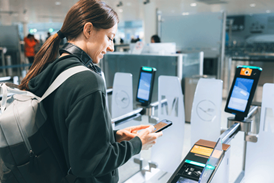

As passenger numbers grow and expectations rise, airport leaders explore how data, collaboration and technology can enable tailored travel experiences – without compromising operational efficiency or commercial performance.

Passenger expectations of airports are changing rapidly. Travellers now expect the same personalised and seamless experiences they receive from digital retailers, hospitality brands and mobile apps. At the same time, airports are facing sustained growth in passenger numbers, operational complexity and infrastructure pressure.
For terminal development managers, the challenge is clear. How can airports deliver personalised journeys while continuing to process ever larger passenger volumes efficiently?
At the International Airport Summit, industry leaders examined how airports can balance these competing priorities. The discussion featured George Ioannou, Director of Innovation at King Salman International Airport Development Company, alongside Chris Miles, Chief Operating Officer at Calgary Airports, Al Titterington, Terminal Operations Director at Birmingham Airport, Gerri Sinclair, Chief Prioritisation, Planning and Performance Optimisation Officer at Vancouver International Airport Authority, and Vickie Lockett, Partner at +impact.
While the conversation covered technology, data and passenger behaviour, one theme stood out throughout the discussion. Personalised journeys cannot be delivered by airports alone. They require alignment across the entire airport ecosystem.
Aligning the airport ecosystem around the passenger
Airports operate within a complex network of stakeholders including airlines, security agencies, border authorities, ground handlers and commercial partners. Each organisation has different objectives and performance targets, which can make delivering a seamless passenger experience challenging.
Talking to people on the front lines who know what works and what does not saves years of trial and error.”
Miles explained that once a passenger arrives at the airport, the focus should shift from competition to collaboration.
“When that passenger arrives at the airport, we are no longer competing airline versus airline,” he said. “We are a community coming together, trying to elevate the experience across all touchpoints.”
For Calgary, this approach has meant aligning partners around a shared mission focused on the passenger journey rather than individual organisational priorities. One area of particular focus has been improving the experience for passenger groups whose needs have historically been overlooked.

“If you take travellers with restricted mobility or families travelling together, there are still many airports that struggle to deliver the right experience,” Miles explained. “If we get the journey right for those passengers, we improve it for everyone else.”
This philosophy is increasingly shaping how airports design passenger journeys. Rather than focusing solely on efficiency metrics, many operators are now looking at how different traveller personas experience the airport environment.
At Birmingham Airport, improving the passenger journey has involved analysing the entire process from curb to gate and identifying friction points that disrupt the experience.
Titterington explained that solving these challenges requires a combination of technology, operational improvement and human expertise.
“We look at three things critically. Technology, continuous improvement and our people,” he said. “Our colleagues who deal with passengers every day are the real heartbeat of what works and what does not.”
One of Birmingham Airport’s recent initiatives has been the introduction of a digital assistant called Babs. Accessible through QR codes across the terminal, the system provides passengers with real-time information about their journey, including gate information, wayfinding and operational updates.
“Customers interact with it and it gives them everything they need for their journey,” Titterington explained. “That allows most passengers to self-serve their way through the airport.”
By automating routine information requests, the system enables frontline staff to focus on passengers who need additional support.
“It allows us to focus our people on families, assisted travel passengers and those who really need that one to one support,” he added.
Even in its early stages, the initiative has delivered measurable operational benefits.
“We have already saved around 14 person days of interactions through the bot,” Titterington stated. “That means our colleagues can spend more time delivering meaningful support rather than answering basic questions.”
Data, trust and the future of personalised journeys
If personalised airport experiences depend on understanding passengers better, data remains one of the biggest barriers facing the industry.
Sinclair highlighted that many airports still lack visibility into who their passengers actually are.
“The airlines know who the passengers are and customs knows who the passengers are,” she expressed. “But as an airport we do not know anything about our passengers when they enter the terminal.”
Without access to that information, delivering hyper-personalised journeys becomes extremely difficult. To address this, Vancouver International Airport is attempting to map every possible passenger interaction across the travel journey.
“We are looking at every touchpoint, from the moment someone is sitting on their couch thinking about travelling somewhere,” Sinclair explained. “That entire journey creates opportunities for engagement.”
A real-time predictive AI enabled journey engine that anticipates each passenger’s needs and automates the right action before they even ask.”
However, data sharing between airlines, airports and other partners remains limited.
“Data simply does not flow well between airlines, retailers, government agencies and airports,” Sinclair said. “What we need is a federated set of standards that allows data to be shared with passenger consent.”

Commercial sensitivities also play a role. Airlines often view passenger data as a strategic asset and may hesitate to share it freely with airport operators.
This makes building passenger trust essential. According to Lockett, transparency and clear value exchange are critical if travellers are expected to share their data.
“Trust is not just built through technical solutions,” she voiced. “It is also a psychological response.”
Lockett outlined three principles for building that trust. First, passengers must be clearly informed about what data is being collected and how it will be used. Second, they must retain control through opt in and opt out mechanisms. Third, there must be a clear benefit to the passenger.
“Passengers are far more willing to share their data if they see an immediate and tangible benefit,” she disclosed. “If we demonstrate faster processing or personalised offers, they are much more likely to engage.”
Beyond improving passenger satisfaction, hyper-personalised journeys also offer clear commercial benefits for airports.
“There is a growing body of evidence showing that improved passenger satisfaction can increase non-aeronautical revenue by between 10 and 20%,” Lockett noted.
Personalisation can also help airports manage passenger flows more effectively. Predictive technologies can identify congestion points and help operators respond dynamically before problems escalate.
Looking ahead, the panel agreed that predictive technologies and artificial intelligence (AI) will play an increasingly important role in shaping the airport journey.
Sinclair described the long-term vision as a system that foresees passenger needs before they arise:
“A real-time predictive AI enabled journey engine that anticipates each passenger’s needs and automates the right action before they even ask.”
Others highlighted the importance of regulatory alignment in enabling innovation across borders. Without consistent frameworks governing data sharing, biometrics and privacy, many of the technologies required for personalised travel will struggle to scale globally.
Despite these challenges, the panel ended on a positive note. Aviation has long benefited from strong collaboration between airports, and that culture of openness remains a powerful driver of innovation.
As Sinclair noted, conversations between industry peers remain one of the fastest ways to accelerate progress.
“Talking to people on the front lines who know what works and what does not saves years of trial and error,” she said.
For terminal development managers facing rising passenger volumes and rapidly evolving traveller expectations, the message was clear: Personalised journeys will play an increasingly important role in the future of airport operations.
Delivering them successfully will depend not only on technology and data, but also on trust, collaboration and a shared commitment across the airport ecosystem to place the passenger experience at the centre of every decision.


No comments yet