

From pairwise to curved approach: how Intelligent Approach is transforming air traffic management.
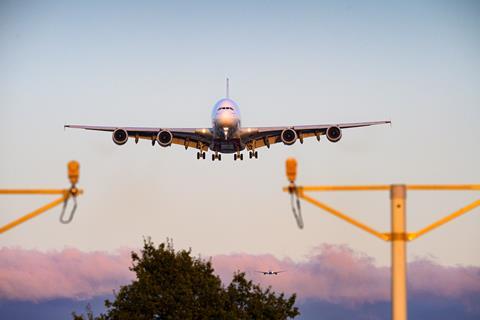
In 2025 August, NATS released an analysis of the first six months of Pairwise separation at Heathrow, highlight some encouraging trends.
The average landing rate, delay performance and carbon emissions have all seen significant improvements since NATS became the first air traffic service in the world to introduce Pairwise as part of the Intelligent Approach arrivals spacing tool.
Developed by NATS and Leidos, Intelligent Approach is the only true time-based spacing tool available today, and Pairwise is just the latest example of how it is helping airports to make the absolute most out of their available runways to maximise operational resilience and efficiency.
Pairwise is a new way of separating arriving aircraft. Traditionally, arrivals have been spaced on final approach by grouping aircraft types into a few categories that take account of an aircraft’s weight and the amount of wake it creates. Pairwise is far more granular and uses the specific characteristics of the individual aircraft type, meaning our controllers can safely reduce the separation between some pairs.
This increases the overall flow of traffic and adds valuable tactical capacity to the operation.
| Jan-May 2024 | Jan-May 2025 | Benefit | |
| Average landing rate 6am-10am | 39.32 arrivals | 40.57 arrivals | 3.2% increase |
| Arrivals with no delay | 17.84% | 24.04% | 6.2 percentage point improvement |
| Average delay per arrival | 5.55 minutes | 4.46 minutes | 19.6% improvement |
| Average CO2 emissions from airborne holding | 1,240kg | 1,000kg | 19.3% cut |
Beyond Pairwise, there are some other developments on the longer-term horizon – amongst them is Curved Approach.
Learn more in our video here:
[arve url="https://www.youtube.com/watch?v=rxPICbRGX-Q&embeds_referring_euri=https%3A%2F%2Fnats.aero%2Fblog%2F2025%2F09%2Ffrom-pairwise-to-curved-approach-how-intelligent-spacing-is-transforming-air-traffic-management%2F&source_ve_path=OTY3MTQ" /]
Today, Intelligent Approach only supports airports where the aircraft fly “straight-in” approaches, typically using the Instrument Landing System (ILS). This is the standard at all major UK airports and at many others around the world, but there are an increasing number that are also making use of what are called Required Navigation Performance (RNP) approaches.
RNP is a form of highly accurate, satellite-based navigation that allows aircraft to fly precisely defined lateral and vertical trajectories. These highly accurate routes can help deliver significant fuel and emission savings but can result in a loss of overall runway throughput in some circumstances.
Curved Approach will help controllers sequence arrivals in multiple RNP routes and more traditional ILS approaches.
By extending the benefits of Intelligent Approach beyond the runway centre line and into the terminal airspace around the airport, we can help controllers to efficiently sequence aircraft on multiple RNP approaches as well as those on the ILS. Curved Approach will help sequence those arrivals via separation indicators on the radar screen, allowing those airports to maintain the valuable carbon and fuel savings whilst not compromising on capacity.
Curved Approach is still at a relatively early stage of development, but it’s expected to be as much of a gamechanger for airport performance as Intelligent Approach has already been at Heathrow, Toronto, Gatwick and Amsterdam.
Find out more about Intelligent Approach.