



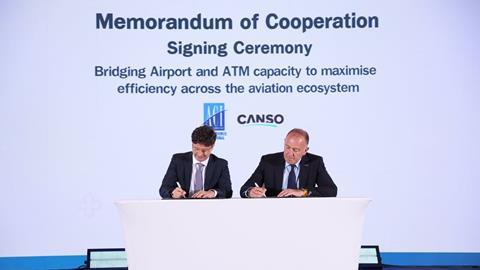
ACI APAC and CANSO have signed a new cooperation agreement focused on improving airport and airspace coordination as regional passenger growth accelerates.
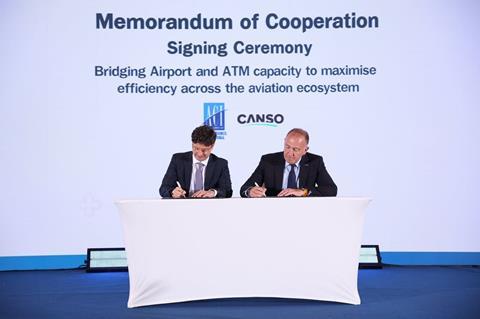
Airports Council International Asia-Pacific & Middle East and Civil Air Navigation Services Organisation have signed a new Memorandum of Cooperation aimed at strengthening coordination between airports and air traffic management providers across Asia-Pacific and the Middle East.
The agreement establishes a formal framework for collaboration between airport operators and the region’s air traffic management community as aviation demand continues to rise rapidly.
ACI APAC and CANSO strengthen airport and airspace planning
The Memorandum of Cooperation was signed on 13 May during the ACI Asia-Pacific & Middle East Regional Assembly, Conference and Exhibition held in Bangkok.
The agreement was signed by Stefano Baronci, Director General of ACI APAC & MID, and Simon Hocquard, President and Chief Executive Officer of CANSO.
Under the partnership, both organisations will work together to assess airport and airspace capacity requirements while identifying operational and infrastructure gaps that could affect future growth.
The agreement also focuses on improving coordination between airport expansion projects and air traffic management development to ensure both areas evolve together.
ACI APAC & MID stated that the collaboration comes at a critical time for the region, with passenger volumes across Asia-Pacific projected to approach 10 billion passengers annually by 2053.
According to the organisations, stronger coordination between airports and air navigation service providers will become increasingly important as demand growth places additional pressure on infrastructure capacity both on the ground and in the air.
The cooperation framework includes work surrounding Airport Collaborative Decision Making, Air Traffic Flow Management and Total Airport Management initiatives.
The organisations will also undertake a regional study examining airport and airspace capacity needs to help ensure the aviation ecosystem remains prepared for long term growth.
Stefano Baronci said airports across Asia-Pacific and the Middle East are entering a period of unprecedented expansion and highlighted the importance of addressing capacity challenges collaboratively across the aviation ecosystem.
Simon Hocquard added that airports and air navigation services cannot operate independently as regional traffic growth accelerates.
The agreement also builds upon a resolution adopted during the ACI Asia-Pacific & Middle East Regional Assembly in New Delhi during April 2025, where airport members committed to supporting optimisation of existing airport and airspace capacity.
Both organisations said the partnership aims to improve operational efficiency, strengthen resilience and support future passenger growth across the region.











No comments yet