



New facility aims to boost regional engineering capability, create skilled jobs and support more sustainable aircraft operations.
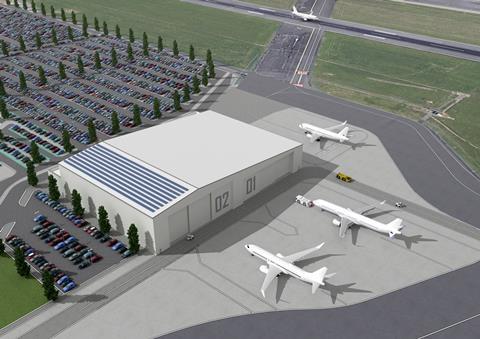
Plans for the West of England’s first dedicated commercial airline maintenance, repair and overhaul (MRO) hangar have been announced as part of Bristol Airport’s long-term expansion strategy.
Concept designs reveal a facility capable of accommodating two aircraft simultaneously, marking a significant step towards enhancing on-site engineering capacity. The project forms part of a wider planning application submitted to North Somerset Council, which seeks to increase the airport’s annual passenger capacity from 12 million to 15 million by the late 2030s.
If approved, the development would create more than 100 highly skilled roles, alongside apprenticeship opportunities designed to strengthen the regional talent pipeline. The hangar would be located within the airport boundary, providing new employment opportunities for local communities in North Somerset.
At present, aircraft based at Bristol Airport must travel elsewhere for maintenance, repair and overhaul. The proposed hangar aims to address this operational inefficiency by enabling routine and planned maintenance to be carried out on-site. Equipped with raised platforms, specialist tools and testing equipment, the facility would reduce the need for repositioning flights, contributing to more efficient and sustainable operations.

Dave Lees, Chief Executive at Bristol Airport, said: “The aircraft maintenance, repair and overhaul hangar for aircraft forms a really important part of our growth plans for the next decade. Not only will it require very highly skilled workers, building on our region’s existing strong engineering capability, but it will also provide apprenticeship opportunities for future generations of local people.
“We’re extremely passionate and proud to be supporting young people who are stepping into employment for the first time and seeking roles in aviation, as well as creating fantastic mid and senior level job opportunities in a region renowned for its incredible aerospace talents.”
Bristol Airport is the largest private employer in the region, with approximately 5,800 people working on-site across more than 50 companies. The airport maintains established partnerships with local colleges to support education, training and employment pathways, and the proposed MRO facility would further expand these initiatives with new engineering and technical roles.
The project has been welcomed by Weston College Group, which highlighted the alignment between the development and regional skills ambitions.
Pat Jones, Principal and Chief Executive of Weston College Group, said: “We are delighted to see continued investment in advanced engineering and aviation skills across the West of England. This proposed development closely aligns with our commitment to creating clear, accessible pathways into high-quality apprenticeships, higher technical education, and long-term careers.
“The opportunities created through this investment would strongly complement the work of our Advanced Manufacturing Technical Excellence College (AMTEC) in Filton - one of only four Technical Excellence Colleges in England. Together, these initiatives strengthen the regional talent pipeline, enabling learners to progress from education and training into highly skilled careers in advanced manufacturing, engineering, and aerospace.“
By partnering with Bristol Airport, we can help ensure local people have the skills, experience and opportunities needed to succeed in these high-growth, high-value sectors. We look forward to supporting the next generation of talent and contributing to the continued success of the region’s aerospace and engineering industries.”
The proposed structure would be a single-storey building incorporating roof skylights and solar panels to support a lower environmental impact. Office space, training areas and staff welfare facilities are also included in the design. Subject to planning approval, construction could begin in the late 2020s.
The hangar proposal sits within a broader programme of infrastructure enhancements at Bristol Airport. These include plans to increase the number of contact stands to 48, reducing reliance on remote stands and bus transfers, alongside passenger experience improvements such as travellators to streamline movement between departure lounges and gates.
Future route development is also under consideration, with ambitions to enable direct long-haul services to North America, the Caribbean and the Middle East, reflecting passenger demand for expanded connectivity.North Somerset Council is expected to make a decision on the airport’s planning application later this year. More than 1,000 individuals and businesses have already submitted letters of support for the proposals.






No comments yet